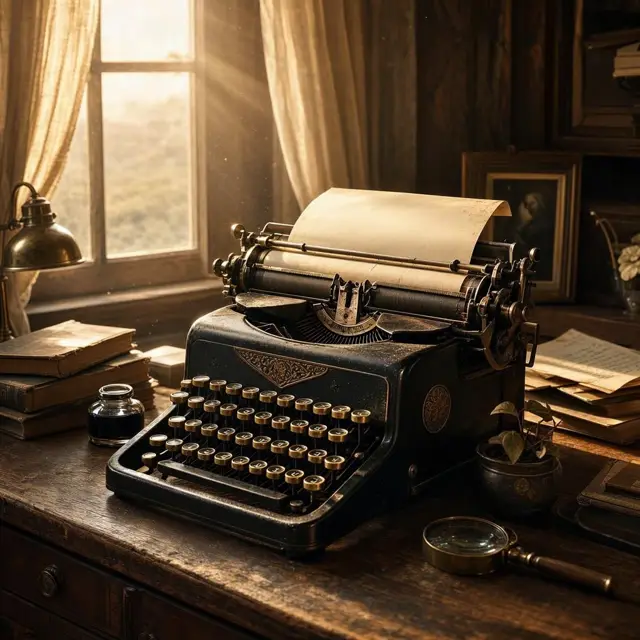
Invented 52 Times Over
Who invented the typewriter? There is no single answer. Historians estimate that some form of it was invented 52 times, as tinkerers in many countries chased a design that actually worked. Back in 1714, Henry Mill got a British patent for a machine that promised writing so neat it could not be told apart from print.
Many early machines were built to help blind people write. In 1802, Agostino Fantoni made a typewriter so his blind sister could write. In 1850, William Hughes built the Typograph with raised keys, and it became a standard tool in British schools for the blind.
There was a speed problem, too. By the mid-1800s, stenographers could take down 130 words per minute, while a writer with a pen topped out at about 30. The first typewriter actually sold to customers was the Hansen Writing Ball from Denmark. It went on sale in 1870 and could only type capital letters.
Sewing Machines, QWERTY and Typing Blind
The first typewriter to sell well was patented in 1868 by a group of Americans in Milwaukee, including Christopher Latham Sholes. A deal was made with E. Remington and Sons, then famous for sewing machines, to sell it as the Sholes and Glidden Type-Writer. That is where the word typewriter comes from. Production began on March 1, 1873.
It had a QWERTY keyboard, and because the machine was a success, other makers slowly copied it. A popular story says the layout was meant to stop the metal arms inside from clashing. That explanation is incorrect, and the real design reasons remain unclear.
Early typists could not even see their words. The arms struck the paper from below, a setup called understrike, so text stayed hidden until the page scrolled up. In 1878, the shift key arrived. It let each arm type two characters, which cut the number of keys in half. Before that, machines had what was basically two full keyboards.
A Very Hard Sell
Selling the first typewriters was tough. Customers compared the $125 Remington to a pen that cost one penny. Some people who received typed letters even felt insulted, believing the sender thought they could not read handwriting. Makers had to train customers to use the machines, and business colleges began teaching typing.
Famous fans helped. Mark Twain saw a Remington in a Boston shop window in 1874 and bought it out of curiosity. He later claimed he was the first important writer to hand a publisher a typed manuscript, for The Adventures of Tom Sawyer. His memory was wrong. The first typed book was Life on the Mississippi, which was also by Twain.
The machine changed offices, too. Office work had traditionally been a man's job, with records written by hand. By the 1900 census, 94.9% of US stenographers and typists were unmarried women. During both World Wars, even more women joined the workforce, often starting out as typists.
The Golf Ball That Ran the Office
In 1961, IBM replaced the rows of metal arms with a spinning ball a little smaller than a golf ball, with letters molded on its surface. This typeball powered the IBM Selectric, and people often just called it the "golfball". It ended jams, when two arms got tangled, and you could swap balls to use several fonts in one document.
The Selectric dominated the office market for at least two decades. IBM marketed it heavily to schools, betting that students who learned on a Selectric would choose IBM later at work. One quirk: its carbon film ribbons could be read after use, so places typing classified documents had to keep track of every used ribbon.
Fixing mistakes got easier as well. Correction fluid, a fast-drying white paint invented by Bette Nesmith Graham, appeared in the 1950s and 1960s. Later, Correcting Selectrics used sticky tape to lift typed letters right off the page.
Still Clacking Today
The typewriter lives on inside your computer. The backspace key once moved the paper back so you could type over a letter. Typists even made an exclamation mark by typing a quote mark, a backspace and a period. The cc line in email stands for carbon copy. Carriage return, tab and shift all come from typewriters, too.
Real machines have not vanished. Many Indian cities and towns still use them in roadside and legal offices, because electricity is not always reliable. Mechanical ones are still common in Latin America and Africa for the same reason. Meanwhile, falling sales pushed IBM to sell its typewriter division in 1991.
Some writers never let go. Cormac McCarthy wrote nearly all his novels and screenplays on an Olivetti he got from a pawn shop in 1963. In 2009, it was auctioned for charity for US$254,500, and he got an identical one for $20 to keep writing. Tom Hanks collects them and gifts signed ones to fans.