The Taste That Was Hiding in Plain Sight
Umami, or savouriness, is one of the five basic tastes, and it is the one people struggle to describe. It is the character of broths and cooked meats: a pleasant brothy or meaty quality with a long-lasting, mouthwatering, coating sensation across the tongue.
The reason it counts as a basic taste rather than a blend is anatomical. People taste umami through receptors that respond to glutamates and nucleotides, and because it has its own receptors rather than arising from a combination of the traditionally recognised ones, scientists now treat it as genuinely distinct.
It behaves oddly on its own. By itself umami is not especially palatable, but it makes an enormous range of other foods pleasant, particularly alongside a matching aroma. Like the other basic tastes, it only works within a fairly narrow concentration range. There is a subtlety too: glutamic acid in acid form gives little umami, and it is the salts of glutamic acid that carry the taste.
1908, and a Bowl of Seaweed Broth
Kikunae Ikeda, a professor at Tokyo Imperial University, was studying why *kombu* seaweed broth tasted so good. In 1908 he identified glutamate as the substance responsible, and noticed the taste was clearly distinct from sweet, sour, bitter and salty. He named it umami, a word that translates roughly as pleasant savory taste.
He moved fast on it commercially. In 1909 Ikeda and Saburōsuke Suzuki founded Ajinomoto Co., which introduced the world's first umami seasoning, monosodium glutamate, and MSG then spread worldwide.
Acceptance took considerably longer than the product did. Scientists debated whether umami was really a basic taste from Ikeda's proposal onward, and the term was only recognised as the scientific description of the taste of glutamates and nucleotides at the first Umami International Symposium in Hawaii in 1985, some 77 years later. The physical proof arrived later still: researchers at the University of Miami identified umami receptors on the tongue in 2000, and in 2006 similar receptors were found in the stomach.
Why Parmesan on Pasta Works
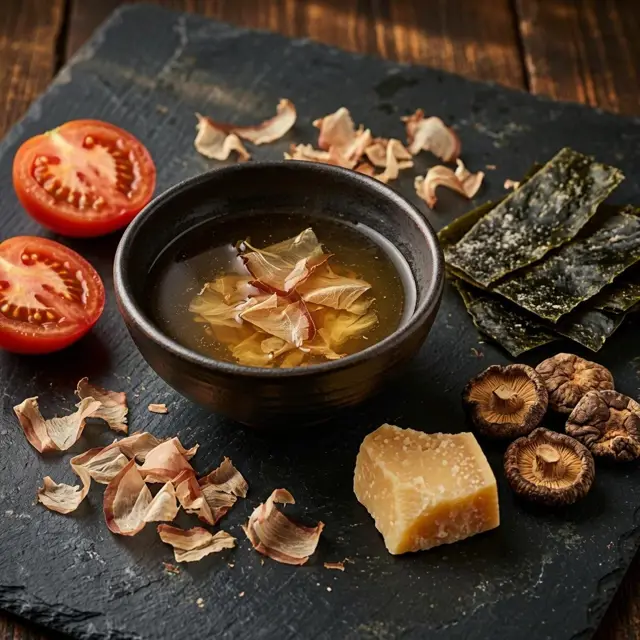
Ikeda's students kept finding more of it. In 1913 Shintaro Kodama discovered that dried bonito flakes contained a second umami substance, the ribonucleotide IMP. In 1957 Akira Kuninaka found that GMP, present in shiitake mushrooms, did the same thing.
Kuninaka then made the discovery that explains a great deal of world cuisine: glutamate and ribonucleotides are synergistic. Combine a food rich in glutamate with an ingredient carrying ribonucleotides, and the resulting taste intensity is higher than you would get by simply adding the two intensities together.
Once you know that, a lot of classic pairings look less like tradition and more like chemistry that cooks found by trial and error. The Japanese make *dashi* from kombu seaweed and dried bonito flakes. The Chinese add leek and cabbage to chicken soup, and Scots do effectively the same thing in cock-a-leekie. Italians grate Parmigiano-Reggiano over an enormous variety of dishes. Nobody involved was reading a paper on ribonucleotides.
Much Older Than Its Name
Cooks had been chasing glutamate for millennia without a word for it. Fermented fish sauces such as *garum*, which are rich in glutamate, were used widely in ancient Rome. Fermented barley sauces called *murri* served the same purpose in medieval Byzantine and Arab cuisine. Fermented fish sauces and soy sauces in China go back to the third century. In the late 1800s the chef Auguste Escoffier was deliberately building dishes that combined this quality with the other tastes, without knowing its chemical source.
The underlying trick is that protein in food is tasteless. Processes such as fermentation, curing or heat treatment are what break it down and release glutamate and other amino acids you can actually taste, which is why aged, cured and fermented foods carry so much of it.
There is a practical payoff. Umami can partly stand in for salt: one study found that using fish sauce as an umami source could cut the salt needed by 10 to 25% in foods like chicken broth, tomato sauce or coconut curry while keeping overall taste intensity. Older people, whose taste and smell may be dulled by age or medication, may benefit particularly.