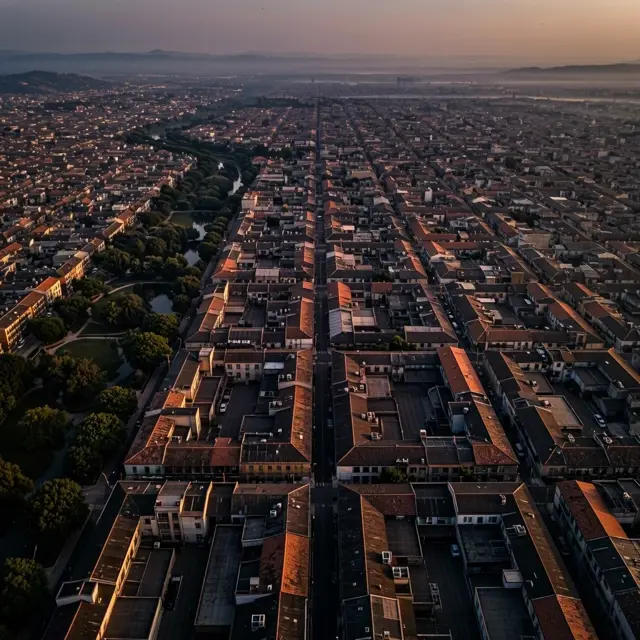
Half a Percent of the Land
The urban heat island (UHI) effect is a meteorological and climatological phenomenon in which urban areas run significantly warmer than the rural areas surrounding them.
The scale of what is causing it is startling. Urban areas occupy about 0.5% of the Earth's land surface — but host more than half the world's population. Half of humanity is concentrated onto a two-hundredth of the land, and that concentration changes the local climate.
The main cause is the modification of land surfaces themselves: replacing soil and vegetation with materials that absorb and hold heat differently. Waste heat from energy use is a secondary contributor, not the primary one. As a population centre grows, it tends to expand its area and raise its average temperature. The term heat island can describe any area hotter than its surroundings, but it generally refers to human-disturbed ones.
Worse at Night, Worse When Still
The effect is not evenly distributed across the day, and that detail matters more than it sounds.
The temperature difference is usually larger at night than during the day. It is most apparent when winds are weak, under blocking conditions, and is noticeable in both summer and winter.
Night is when a heat island does its real damage. Bodies rely on cooler night-time temperatures to recover from daytime heat, so a city that stays warm after dark removes the recovery period rather than merely making the afternoon less pleasant. The reason is stored energy: surfaces that absorbed heat all day release it slowly through the night, and without wind to carry it away, it simply sits over the city.
It Changes Rain, Air and Water
A heat island does not stay in the thermometer. Its consequences spread into systems most people would never connect to city temperature.
Monthly rainfall is greater downwind of cities, partly due to the UHI — a city can alter the weather of the land beyond it.
The other effects are less benign:
- Increased heat lengthens growing seasons in urban centres
- It decreases air quality, by increasing production of pollutants such as ozone
- It decreases water quality, as warmer water flows into local streams and stresses their ecosystems
That last one is easy to miss. Rain falling on hot pavement runs off warm, and the temperature of a stream is one of the tightest constraints on what can live in it.
Trees, Roofs, and Lighter Colours
Not every city has a distinct heat island. The characteristics depend strongly on the background climate of the area where the city sits, and the impact can change significantly with the local environment.
Where it does occur, the countermeasures are largely about shade, evaporation and reflection:
- Tree cover and green space, providing shade and promoting evaporative cooling
- Green roofs and passive daytime radiative cooling
- Ventilation corridors to let air move through the built environment
- Lighter-coloured surfaces and less absorptive building materials, which reflect more sunlight and absorb less heat
One clarification is worth stating plainly, because it is routinely muddled: climate change is not the cause of urban heat islands. But it is producing more frequent and intense heat waves, which in turn amplify the effect in cities. Compact, dense urban development may also increase it, raising temperatures and exposure together.