The Burrs That Would Not Come Off
In 1941, the Swiss engineer George de Mestral returned from a hunting trip in the Alps with his dog and found both of them covered in burdock burrs.
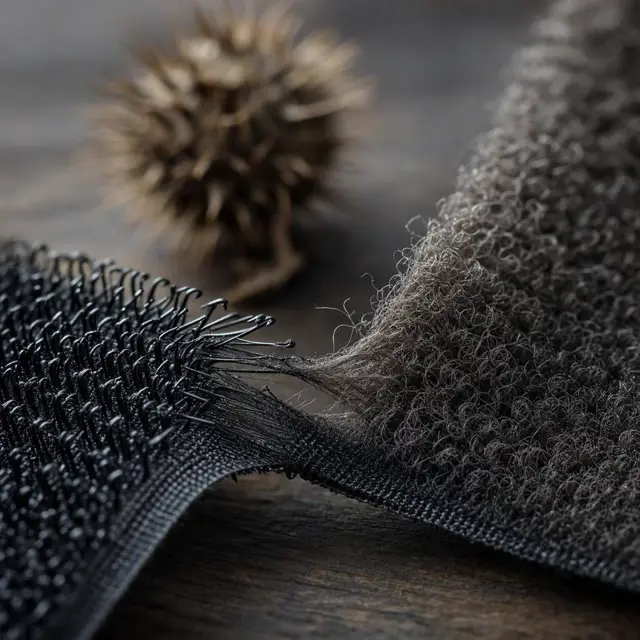
Most people pick the burrs off and think no more about it. De Mestral put one under a microscope — and found hundreds of tiny hooks that caught on anything with a loop.
That is the entire invention, borrowed wholesale from a plant that had been using it to hitch rides on passing animals for millions of years. The result is a hook-and-loop fastener: two complementary surfaces, one covered in tiny stiff hooks, the other in soft loops. Press them together and the hooks catch; peel them apart and they release, with the distinctive ripping sound everyone recognises. The name is a compression of two French words — *velours* (velvet) and *crochet* (hook).
Ten Years to Make It by Machine
Seeing the principle was quick. Manufacturing it was not.
De Mestral submitted his Swiss patent in 1951 and received it in 1955. Along the way he found that nylon, when sewn under hot infrared light, naturally forms hook shapes — the material would make the hooks for him, if handled correctly.
Mechanising the full production process still took roughly a decade: about eight years to work out how to weave the hooks, and another year to develop the trimming loom that cut them to shape. That gap between insight and product is the part the story usually skips. A man saw the answer in 1941 and could not reliably build it until the mid-1950s, because copying a burr turns out to be an industrial engineering problem, not a botanical one.
NASA Did Not Invent It
One of the most persistent myths about space technology is that NASA invented Velcro. It did not — but it adopted it heavily, which is probably how the myth started.
Apollo missions used it extensively on suits and equipment, and Space Shuttles carried ten thousand inches of a special fastener made of Teflon loops, polyester hooks and glass backing. In microgravity, where anything set down simply drifts away, a surface that grips on contact is not a convenience but a necessity.
There is a darker entry in that record. Roughly 3.2 square metres of it sat near ignition sources in the Apollo command module, contributing to the combustible materials involved in the Apollo 1 fire. The same property that made it invaluable — being everywhere, in quantity — made it part of a catastrophe.
The Name Its Owner Wants Back
Velcro is a trademark of Velcro Companies, appearing in over 300 registrations across more than 159 countries. It is also, in ordinary speech, simply what everyone calls the thing.
That is a serious commercial problem rather than a compliment. When a brand name becomes the generic term for a product category, the trademark can weaken — so the correct terms are hook-and-loop fastener, hook-and-pile fastener, or touch fastener.
The fastener now appears across clothing, accessories, and countless industrial and consumer applications. Its one notable weakness is acoustic: that satisfying rip is a genuine disadvantage in military use, where opening a pocket announces your position to anyone listening. An invention copied from a plant, made practical by nylon, carried to the Moon — and undone, in one specific situation, by being too loud.