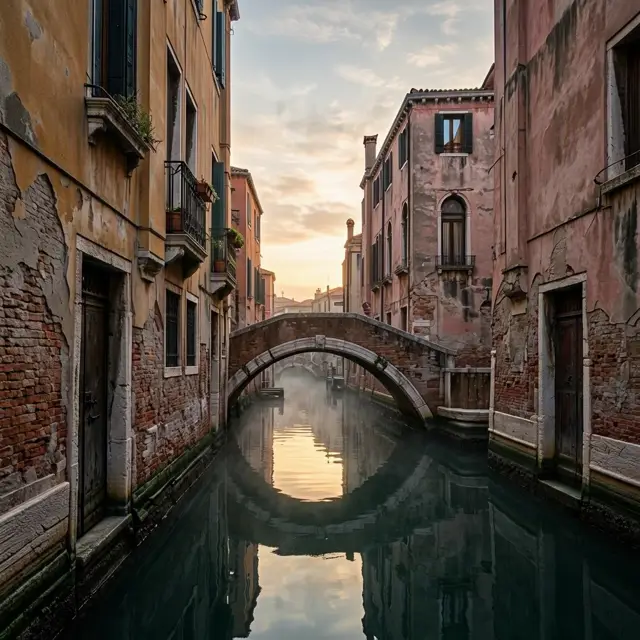
A Hundred and Twenty-Six Islands
Venice is a coastal city in northeastern Italy and the capital of the Veneto region, and its construction is genuinely improbable. It is built on a group of 126 islands, separated by expanses of open water and by canals, with parts of the city linked by 472 bridges.
Those islands sit in the shallow Venetian Lagoon, an enclosed bay between the mouths of the Po and the Piave rivers — more precisely between the Brenta and the Sile.
The name comes from the ancient Veneti people who inhabited the region by the 10th century BC. Its nicknames read like a list of everything a city can be: La Dominante, La Serenissima — "the most serene" — Queen of the Adriatic, City of Water, City of Masks, City of Bridges, The Floating City, City of Canals. Few places accumulate that many names without earning them.
The First Real Financial Centre
Venice was the capital of the Republic of Venice for almost a millennium — from 810 to 1797. Across the Middle Ages and Renaissance it was a major financial and maritime power, a staging area for the Crusades and the Battle of Lepanto, and a crucial centre of commerce in silk, grain and spice.
The strongest claim is financial. The city-state is considered to have been the first real international financial centre, emerging in the 9th century and reaching its greatest prominence in the 14th. That made Venice wealthy for most of its history.
It was also an industrial pioneer. The Venetian Arsenal is considered by several historians to be the first factory in history, and was the base of Venetian naval power. A city with no farmland and no natural defences beyond water invented modern finance and mass production instead — then used both to run an empire of territories along the Adriatic and into the Italian peninsula. Venetian sovereignty ended in 1797 at the hands of Napoleon, and the city joined the Kingdom of Italy in 1866.
Fifty Thousand People in the Postcard
Here is the fact that reframes every photograph you have seen. As of 2025, the comune of Venice has 249,466 inhabitants — but fewer than 50,000 live in the historical island city, the centro storico that the entire world pictures.
Most of the population lives on the mainland, the *terraferma*, with about 25,000 on other islands in the lagoon.
So the Venice of the imagination — the canals, the bridges, the crumbling palazzi — is home to a population smaller than a modest town, inside a metropolitan area of 2.6 million when counted together with Padua and Treviso. The most famous urban landscape on Earth is, in residential terms, nearly hollow.
Beautiful, and Under Constant Threat
Venice is known for major artistic movements, especially during the Italian Renaissance, and it played an important role in the history of instrumental and operatic music — it is the birthplace of the Baroque composers Tomaso Albinoni and Antonio Vivaldi.
The praise has never really stopped. *The Times* has described it as one of Europe's most romantic cities, and *The New York Times* called it "undoubtedly the most beautiful city built by man." The lagoon and the city within it were inscribed as a UNESCO World Heritage Site in 1987, covering 70,176.4 hectares.
But the threats are structural and stacking up: overtourism, pollution, tide peaks, and cruise ships sailing too close to buildings. Because Venice and its lagoon are under constant threat, its UNESCO listing has itself been under constant examination — the rare case of a place so endangered that even its protected status is repeatedly in question.