A Cloud You Can See From 50 Kilometres Away
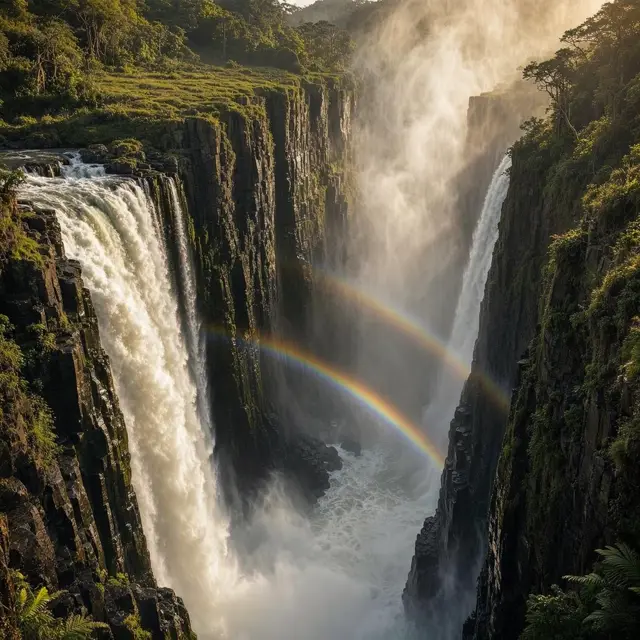
Most waterfalls announce themselves with noise. Victoria Falls does it with a cloud. The spray usually rises more than 400 metres into the air, sometimes twice as high, and it can be seen from up to 50 km away. At full moon, visitors can even spot a moonbow, a rainbow made by moonlight.
No wonder the local names are so vivid. In the Lozi language it is Mosi-oa-Tunya, the smoke that thunders. Older names recorded by David Livingstone, Seongo and Chongwe, mean the place of the rainbow. Several peoples around the river gave it names that all mean roughly the same thing.
Livingstone reached the falls on 16 November 1855 and named them after Queen Victoria. Yet the old name never went away. Both names are recognised on the World Heritage List, and Zambia even named its national park at the falls Mosi-oa-Tunya.
The Biggest Sheet of Falling Water on Earth
Victoria Falls wins on teamwork. Put its width of 1,708 metres together with its height of 108 metres, and you get the largest sheet of falling water in the world.
The setup is strange. Far upstream, the Zambezi River slides calmly across a flat plateau of basalt, dotted with tree-covered islands. Then the whole width of the river drops at once into a long crack in the rock. That crack, called the First Gorge, runs across the river instead of along it.
Here is the twist. The only way out of the First Gorge is a gap just 110 metres wide. The entire river squeezes through it. It then zigzags through a chain of gorges and swirls into a deep pool called the Boiling Pot, where the water at high flow turns in enormous, slow whirlpools.
A Waterfall That Keeps Moving Upstream
The Zambezi did not always flow this way. It once drained south to join the Limpopo River. About 2 million years ago the land rose and blocked that route. A large lake, known as a paleolake, filled the basin. It had no outlet at all.
About 20,000 years ago, in a wetter climate, the lake finally spilled over to the east. The escaping water began cutting the Batoka Gorge through the basalt, which itself formed around 200 million years ago.
The gorge below the falls is really a record of old waterfalls. It holds six separate gorges and eight past positions of the falls. Each time, headward erosion ate back along a weak line in the rock until a new drop took over. And it may be happening again. At one end of the falls, where the lip is lowest and the water is strongest, the river may already be carving the next gorge.
A Bridge Built to Get Trains Wet
Before 1905, the only way over the river near the falls was by dugout canoe or a barge pulled on a steel cable. Then came plans for a railway, and a very unusual request. Cecil Rhodes insisted the new bridge be built where the spray from the falls would land on passing trains. So the Second Gorge was chosen.
The Victoria Falls Hotel opened in 1904 for visitors arriving by rail. From 1905 the trains ran from as far south as the Cape. Tourism has shaped the place ever since.
Today visitors raft the gorges, bungee jump from the bridge, kayak and take sightseeing flights. The boldest head for a natural rock pool right on the lip of the falls on the Zambian side. Between about September and December, a rock barrier calms the current enough for swimmers to splash about in front of the drop.
A Rainforest Made of Spray
The falls change hugely through the year. The flood peaks in April. By November the flow can fall to around a tenth of that. From September to January up to half of the rock face may run dry, and people can even walk across parts of the river at the top.
The spray creates its own small world. A rainforest grows on it, holding plants that are rare in the area, such as ebony, ivory palm and wild date palm. Outside that wet strip, open woodland and savannah take over.
The falls also act as a wall for fish. There are 84 species above the falls and only 39 below them. But the falls face a warming, drier climate. In 2019, unusually low rain cut the flow to its lowest level in a century.