Most Volcanoes Are Underwater
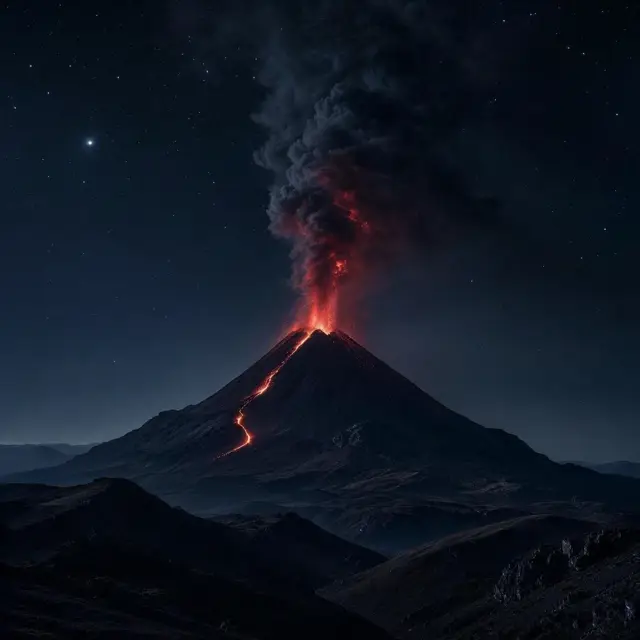
A volcano is a vent or fissure in the crust that lets hot lava, volcanic ash and gases escape from a magma chamber below the surface. That is the whole definition, and it explains where they turn up.
Volcanoes form most often where tectonic plates are pulling apart or pushing together. Because most of Earth's plate boundaries lie under the ocean, most of Earth's volcanoes are underwater, invisible and unvisited.
The two types behave very differently. Where plates diverge, as along the Mid-Atlantic Ridge, eruptions are usually not explosive. Where plates converge, as around the Pacific Ring of Fire, the eruptions turn violent.
The Plume That Builds Islands
Some volcanoes appear nowhere near a plate boundary at all, and for a long time that was a puzzle.
The most likely explanation is mantle plumes: upwellings that rise from the core-mantle boundary, some 3,000 kilometres deep inside the Earth. A plume can thin the crust above it and punch through, producing hotspot volcanism.
Because the tectonic plate above keeps moving while the plume stays put, the result is a chain of volcanic islands, each one built and then carried away. The Hawaiian hotspot is the classic example. Volcanoes can also form where the crust is being stretched and thinned, as in the East African Rift, the Wells Gray-Clearwater volcanic field, and the Rio Grande rift in North America.
Dormant Does Not Mean Asleep
Volcanoes get sorted into three labels: active, dormant and extinct. The labels are less reassuring than they sound.
Active volcanoes have a history of eruption and are likely to erupt again. Extinct volcanoes cannot erupt at all, because they no longer have a magma source. Dormant volcanoes are the awkward middle: generally defined as not having erupted since the start of the Holocene, about 12,000 years ago, but fully capable of erupting again.
Here is the twist. Dormant volcanoes are technically still considered seismically active. The categories are not uniform, and for some volcanoes they overlap outright.
When a Mountain Changes the Weather
A large enough eruption does not just damage its surroundings. It can cool the planet.
Ash and droplets of sulfuric acid thrown high into the atmosphere obscure the Sun and cool Earth's troposphere. Historically, big eruptions have been followed by volcanic winters, and those winters have caused catastrophic famines.
Volcanism is not an Earth-only phenomenon either. Venus has very numerous volcanoes and Mars has significant ones. In 2009 a paper even proposed widening the definition of the word to cover cryovolcanism, suggesting a volcano be defined as an opening on a planet or moon's surface that erupts magma, as defined for that body, or magmatic gas.