The Name That Means Nothing
Wi-Fi does not actually stand for anything. The name was coined in 1999 by the branding firm Interbrand, which was hired to find something catchier than "IEEE 802.11b Direct Sequence", the technology's real title. Interbrand pitched ten candidate names, and Wi-Fi won.
Many people assume it is short for "Wireless Fidelity". The Wi-Fi Alliance even briefly used that phrase as a slogan, but the organization never officially confirmed the meaning, and the debate has never fully died down.
The familiar logo does carry real meaning, though. It marks products that passed the Alliance's testing, a promise that any "Wi-Fi Certified" gadget will connect with every other certified device, no matter which company built it. By 2017, more than 800 companies around the world had joined the Alliance.
A Breakthrough With Many Parents
No single country can claim Wi-Fi. In 1991, NCR Corporation and AT&T developed a system called WaveLAN in the Netherlands, the direct ancestor of the 802.11 standards. That same year, Australian researchers began their own wireless work, and the research agency CSIRO built a prototype in 1992 and filed a patent that would later prove extremely valuable.
The first official 802.11 protocol arrived in 1997 and moved data at just 1 to 2 megabits per second. Two years later, a faster version lifted that to 11 megabits, and Apple's 1999 iBook laptop became the first mass consumer product with built-in Wi-Fi, sold under the AirPort brand.
The patent story ended in headlines. CSIRO collected 200 million dollars from 14 technology companies in a 2009 settlement, then another 220 million dollars in 2012.
How Invisible Waves Carry the Internet
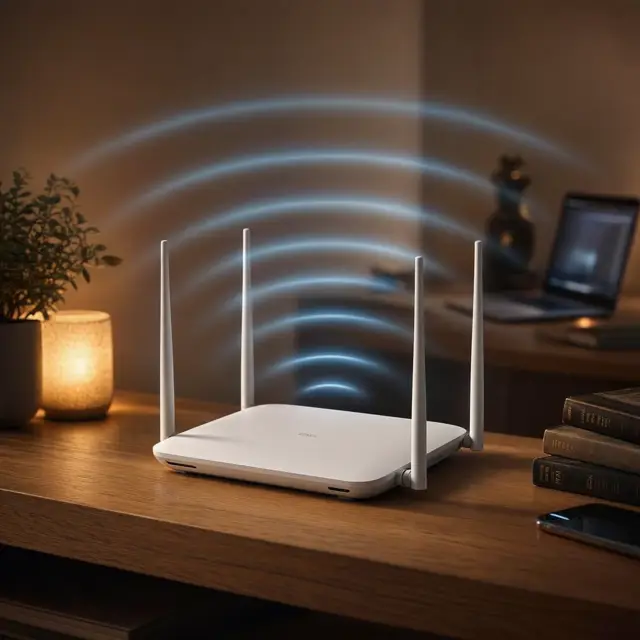
Under the hood, Wi-Fi is simply radio. Devices exchange small chunks of data called data packets over the 2.4, 5, and 6 gigahertz radio bands, which are sliced into channels that nearby networks share. On the crowded 2.4 gigahertz band, North America effectively has only three channels that do not overlap.
The waves work best with a clear line of sight. Walls, pillars, and home appliances all weaken the signal, which is why a typical access point reaches only about 20 meters indoors. The 2.4 gigahertz band also has noisy neighbors: microwave ovens, cordless phones, Bluetooth devices, and baby monitors can all interfere with it.
To avoid chaos, Wi-Fi devices are polite. A device listens to the channel first and only transmits when no one else is talking, a scheme designed to minimize collisions between competing signals.
From Megabits to Gigabits
The speed climb has been staggering. The original 1997 standard managed 2 megabits per second, while Wi-Fi 7, released in 2024, can reach 23 gigabits per second on suitable hardware at close range. In 2018, the Wi-Fi Alliance introduced the simple generation names, like Wi-Fi 5 and Wi-Fi 6, so consumers would no longer need to decode labels such as "802.11ax".
Adoption numbers are just as dramatic. As of 2019, over 3.05 billion Wi-Fi-enabled devices were being shipped globally every single year.
Engineers have also pushed the limits for fun. In 2007, a non-standard link stretched 382 kilometers between two Venezuelan mountaintops, and the Swedish National Space Agency reached a stratospheric balloon 420 kilometers away using 6-watt amplifiers. CSIRO's original prototype was even chosen as Australia's contribution to the "A History of the World in 100 Objects" exhibition in 2016.