From Grain Mills to a Vienna Show
Wind has been doing jobs for people for a very long time. The windwheel of Hero of Alexandria, from the first century, is one of the first recorded machines powered by wind. The first known practical wind power plants came from Sistan, in Persia, from the 7th century. Their sails of reed matting or cloth spun on tall upright shafts to grind grain and draw up water.
Electricity came much later. In 1883, Josef Friedländer installed the first electricity-generating wind turbine at the Vienna International Electrical Exhibition. It charged batteries that ran lamps, tools and even a threshing machine. In 1887, Scottish academic James Blyth used a wind machine to light his holiday home.
By 1900, Denmark had about 2,500 windmills and wind pumps. Around the time of World War I, American makers were turning out 100,000 wind turbines a year, mostly to pump water. Then power lines reached the countryside in the 1930s, and the rural turbine boom faded.
The 59.3% Ceiling
No turbine can grab all of the wind's energy. The air has to keep flowing out the back, so it always carries some energy away. Physics sets a hard ceiling called Betz's law: at most 16/27, or 59.3%, of the wind's kinetic energy can ever become power.
Real machines get fairly close. In 2001, commercial turbines delivered 75% to 80% of that limit at their rated speed. Wind speed matters most of all, because the power a turbine could catch rises with the cube of wind speed. That is why builders love windy coasts, mountain ridges and tall towers.
Small things add up, too. Dust and dead insects on the blades change their shape and slowly cut their efficiency. A study of 3,128 Danish turbines older than 10 years found that half had no drop at all, while the other half lost 1.2% of their output each year.
Giants With Three White Blades
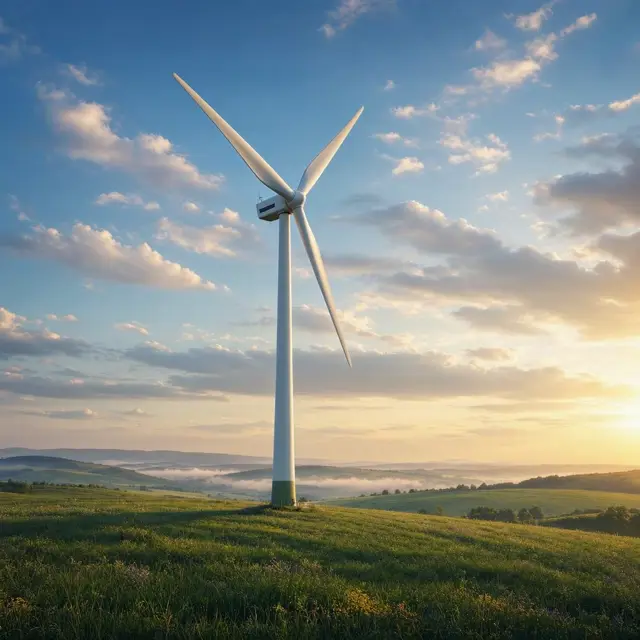
Most of the world's wind power comes from big three-bladed machines that spin on a horizontal shaft and face into the wind. Small ones point themselves with a simple vane, while big ones use a wind sensor and a turning system. Three blades give a smooth spin, which helps them run reliably.
The blades are usually white so pilots can see them in daylight, and they get bigger every year. Offshore turbines now reach 26 megawatts with blades up to 153 meters long, while onshore ones reach 15 megawatts and 131-meter blades. In the U.S., the average onshore hub sits 103 meters up.
Up top sits the nacelle, the housing that holds the generator. On a common 1.5 megawatt model in the United States, it weighs around 300 tons and perches on an 80-meter tower. A 100-meter glass fiber blade alone can weigh up to 50 tonnes. Using carbon fiber in the blade's main beam can save about 15 tonnes.
Eggbeaters, Scoops and Flying Wings
Not every turbine looks like a giant fan. So-called vertical-axis turbines spin around an upright shaft, so they work no matter which way the wind blows. The Darrieus design, patented in the 1920s, is nicknamed the eggbeater turbine. The Savonius uses scoops and shows up in wind gauges and in the spinning vents on bus and van roofs.
Rooftops can give them a boost. A building pushes wind up and over its roof, which can double the wind speed at a rooftop turbine. The catch is that upright designs make much less energy over time than the classic three-bladed kind.
Some ideas go even further. Airborne wind turbines are wings or small aircraft tied to the ground, built to reach the faster winds higher up, and prototypes are running in east Africa. Floating turbines sit on platforms at sea, where deeper water leaves room for more of them, farther out of sight from land.
Drones, Bridges and Cheaper Power
Keeping turbines spinning takes work. At best, they are ready to generate power 98% of the time. Ice is a big enemy in cold places, so blades are de-iced with internal heating or, in some cases, by helicopters or drones spraying clean warm water on them.
A turbine lasts about 30 years on average. About 85% of its materials are easy to reuse or recycle, but the blades are hard because their resin cannot be remolded. People are getting creative: old blades have become parts of footbridges in Poland and Ireland, and in Germany they help fuel a cement factory. In 2026, Chinese maker Ming Yang developed the first fully recyclable wind turbine.
Prices keep falling. A turbine cost about $2,324 per kilowatt in 2010 and about $1,041 by 2024. In 2024, the Al Ghat wind farm project in Saudi Arabia set a global record for cheap wind power at only $15.66 per megawatt-hour.