A toy from 440 BC
The yo-yo is not a modern craze. It has been documented since 440 BC. The Ancient Greeks knew it, and yo-yos show up in several Ancient Greek vase paintings. Some Greek yo-yos made of bronze and fired clay still survive, though most were probably made of wood. Nobody knows what the Greeks called them.
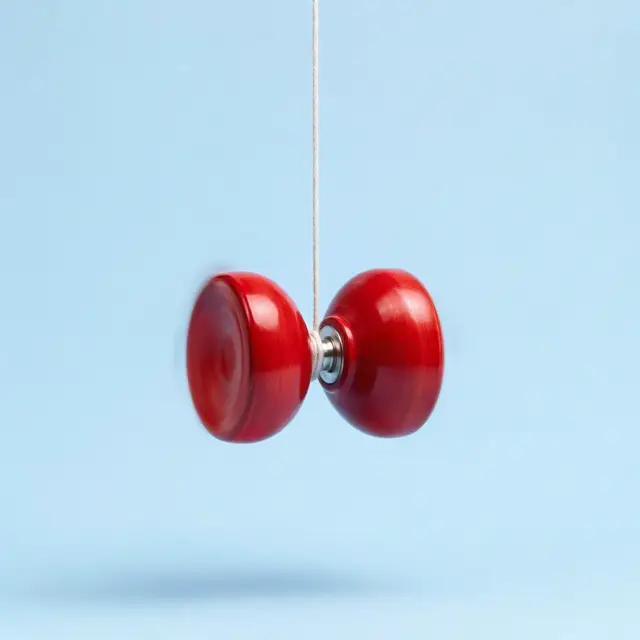
The design is simple. Two disks sit on an axle, and a string wraps around the axle like thread on a spool. You hook the free end on a finger, usually the middle or ring finger, and let the toy drop. Gravity and the throw make it spin, and that spin carries it back up to your hand.
In England around the end of the 18th century, yo-yos were popular under a different name: bandalores. The word yo-yo itself probably comes from yóyo, a term in Ilocano, a language of the Philippines.
The loop that changed everything
In 1928, Pedro Flores, a Filipino immigrant to the United States, opened the Yo-yo Manufacturing Company in Santa Barbara, California. He started with a dozen handmade toys. By November 1929, he had two more factories, 600 workers, and an output of 300,000 yo-yos a day.
His secret was the string. Older yo-yos had the string tied to the axle with a knot. They just went up and down, and they could never stay spinning at the bottom. Flores used a looped slip-string instead, one long piece twisted so a loop fits loosely around the axle.
That small change made the sleeper possible. With the loop, there is not enough friction to pull the yo-yo back up, so it keeps spinning at the end of the string. A quick jerk of the wrist creates slack. The string then wraps around the axle, friction rises, and the yo-yo climbs back to your hand.
How Duncan lost the word yo-yo
Around 1929, businessman Donald F. Duncan saw the potential of this new fad. He bought Flores's company and everything it owned, including the Flores name. In 1946, Duncan opened a yo-yo factory in a town called Luck, Wisconsin.
Duncan held the trademark on the name Yo-Yo in the United States. When sales dropped after World War II, he launched a comeback in 1962 with a series of television ads. Then came a legal fight. In 1965, a federal appeals court ruled for a rival, the Royal Tops Company. It said yo-yo had become part of everyday speech, so Duncan no longer owned the word.
The legal costs, along with other money troubles, pushed the Duncan family to sell the company name in 1968 to Flambeau, the firm that had made Duncan's plastic yo-yos since 1955. In Canada, though, Yo-yo has been a registered trademark since 1932 and still is.
A dentist, ball bearings and a 30-minute spin
One yo-yo celebrity was a dentist. In 1979, Tom Kuhn patented the No Jive 3-in-1, the world's first take-apart yo-yo, which let players swap the axle. In 1990, his SB-2 became the first successful yo-yo with a ball bearing.
Bearings cut friction while the yo-yo spins, which let players invent longer and harder tricks. Makers kept pushing. Some high-end bearings use ceramic balls, and in May 2018, Wolf Yoyo Works tested a prototype bearing made with ruby, chosen for its extreme hardness.
The numbers show the difference. A cheap fixed-axle yo-yo usually spins for 10 to 20 seconds. A ball-bearing yo-yo can spin for about 1 to 4 minutes. As of 2010, the record sleep time was 3:51.54 for a fixed axle and 21:15.17 for a bearing model. In 2012, the C3YoyoDesign BTH pushed that record past 30 minutes, to 30:28.30.
Styles with codes for names
Modern competitions sort yo-yo play into divisions with short codes. The most popular style is 1A, played with an unresponsive yo-yo. It does not come back when you tug the string. Instead, you do a bind, which gets it to grip the string and return. 2A means looping two yo-yos at once, one in each hand. 3A is string tricks with two yo-yos, and its mounts are called houses.
In 4A, or off-string, the string is not tied to the axle. It gets launched into the air and caught again on the string. In 5A, the string is not tied to your hand. It ends in a counterweight that gets thrown and swung as part of the trick. Steve Brown developed this style in 1999.
One popular belief is simply false. There is no sound evidence yo-yos were ever weapons. That idea was likely a marketing gimmick spread by Duncan's early demonstrators.