A name borrowed from rubber boots
The zipper was once called a "clasp locker", which is a far less catchy name. Its modern name came in 1923 from the B. F. Goodrich Company. The company used the fastener on a new type of rubber boots, or galoshes, which could be closed with a single zip of the hand. It called the fastener the zipper, and the name stuck.
The word copies a sound. A zipper makes a high-pitched zip when you use it. In the UK, people usually just say "zip".
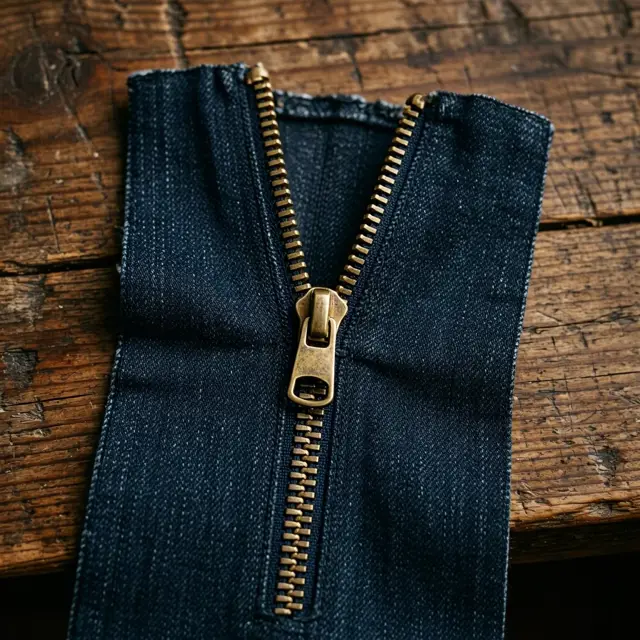
The design is clever but simple. Two rows of metal or plastic teeth sit on fabric tape. A slider runs along them. Inside it is a Y-shaped channel that pushes the teeth together or pulls them apart, depending on which way it moves. Each tooth fits snugly into the next, like a lock and key. Once locked, the everyday forces on a worn garment cannot pull the teeth apart.
A shoe fastener that flopped
The zipper story starts with a near miss. In 1851, Elias Howe, whose sewing machine had become widely popular, got a patent for an "Improvement in Fastenings for Garments". He never seriously tried to sell it. His device was also more like a fancy drawstring than a real zipper.
In 1893, Chicago inventor Whitcomb L. Judson patented a "Shoe-Fastening". He wanted something to replace boot laces. Judson and his partner Lewis Walker even fitted the device to their own boots. The early version worked, but it kept jamming.
Judson called it the "clasp locker" and showed it off at the 1893 Chicago World's Fair. Almost nobody paid attention, and it had little commercial success. Judson is sometimes called the inventor of the zipper, but his device was never used in clothing. Still, his company, the Universal Fastener Company, would later hire the man who finally got it right.
The engineer who fixed it
That man was Gideon Sundbäck, a Swedish-American electrical engineer hired in 1906. He redesigned Judson's fastener to make it tougher. He packed in far more teeth, going from four per inch to ten or eleven. He also added two facing rows of teeth that the slider pulled into a single piece. The zipper first went on sale in 1913, and his patent for the "Separable Fastener" followed in 1917.
Sundbäck also built the machine to make it. It took a special Y-shaped wire, cut small scoops from it, shaped them and clamped each one onto cloth tape. In its first year, it produced a few hundred feet of zipper per day.
He later used his non-US rights to set up a company in St. Catharines, Ontario. That led to a common misconception that he was Canadian and that the zipper came from Canada. Meanwhile, in 1916, a live model showed off the "new hookless fastener" in a shop window in Melbourne.
The Battle of the Fly
In its early years, the zipper was mostly used to close boots and pouches. Clothing came later. In 1925, Schott NYC started putting zippers on leather jackets.
In the 1930s, a sales campaign targeted children's clothes. It praised zippers for helping young children dress themselves and become more self-reliant. Then came a showdown with the button. In 1937, the zipper won the "Battle of the Fly" after French fashion designers raved about zippers in men's trousers. A Talon advertisement in the first Esquire magazine called it the "Newest Tailoring Idea for Men". Among its virtues, the ad said, it would rule out "The Possibility of Unintentional and Embarrassing Disarray."
Not everyone was a fan. In the novel Brave New World, Aldous Huxley mentioned zippers again and again. He hinted that their newness, speed and ease of use were somehow bad for natural human values. Today, the zipper is by far the most widespread fastener there is.
Space suits and a zipper with three sides
Some zippers do jobs Judson never dreamed of. NASA developed airtight zippers for high-altitude pressure suits and later space suits. They keep air pressure inside a suit even in the vacuum of space. A plastic sheet around each row of teeth squeezes shut to form a double seal. The catch is that they are very stiff and hard to open. Similar zippers now seal diving dry suits and hazmat suits.
The industry has its giants. Japanese maker YKK grew to dominate by the 1980s and held 45 percent of the world market, according to a 2003 report. In 2025, YKK announced a tapeless zipper with the teeth attached straight to the fabric.
Then there is the strangest design of all, the three-sided Y-zipper. Invented in 1985, it zips three strips together into a rigid beam. Forty years later, an MIT team showed it could easily be 3D-printed. They suggested it could help things like tents switch between soft and rigid.