Hundreds of Tiny Countries
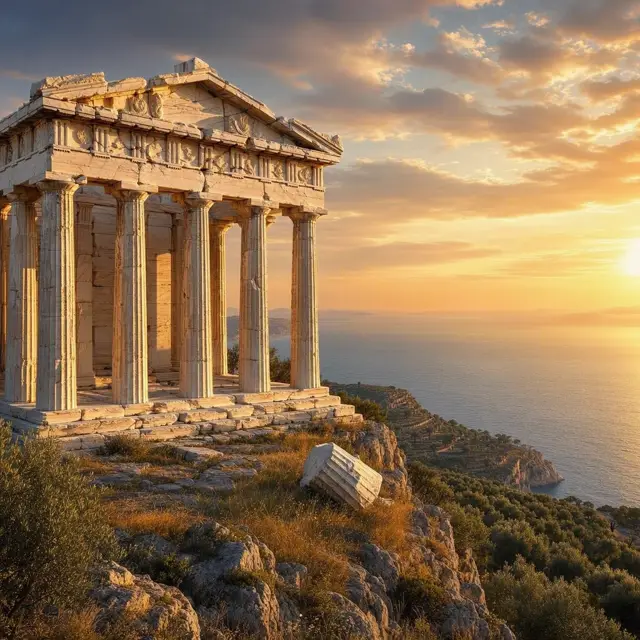
Ancient Greece was never really one country. It was a loose collection of several hundred independent city-states, each with its own government. The Greeks saw themselves as one people, sharing a language and culture, but each city fiercely guarded its independence.
The land helped keep them apart. Greece is split up by hills, mountains and rivers, so small communities grew up separately.
When there was no more room at home, the Greeks spread out. From about 750 to 500 BC, they founded colonies all around the Mediterranean and Black Sea. Several of today's great cities began this way, including Naples, Marseille and Istanbul, which started as the Greek colony of Byzantion.
The Birth of Democracy
Athens changed history with a bold experiment. After a period of rule by a single strongman, the Athenians founded the world's first democracy, a system where citizens ruled together.
All citizens could attend the main assembly, where city matters were debated, and each had equal rights there. It was a radical idea at the time.
But it had limits. Only citizens counted, so foreigners living in Athens and slaves had no political rights at all. Other cities chose differently. Sparta, the great rival of Athens, was ruled by two kings at the same time, whose power was kept in check by a council of elders and special officials who watched over them.
Thinkers Who Shaped the World
The Greeks loved to ask why. Their philosophy focused on reason and careful questioning. Early thinkers tried to explain the world through nature rather than myths.
Then came three of the most famous names in history. Socrates never wrote down his own ideas, yet he laid the base of Western philosophy. His student Plato wrote The Republic. Plato's student Aristotle wrote about everything from nature to ethics.
Their ideas travelled far. They passed to Muslim philosophers and scientists in the Middle Ages, then on to the European Renaissance, and into modern science. Greek poetry also gave us Homer, while Athens gave the world tragic and comic theatre.
Putting the Sun at the Centre
Greek thinkers were also brilliant at maths and science. They set out the basic rules of geometry and the idea of a formal mathematical proof. Discoveries by Pythagoras, Euclid and Archimedes are still taught in schools today.
They looked to the stars too. In the 3rd century BC, Aristarchus of Samos was the first to suggest a heliocentric system, with the Earth moving around the Sun. Eratosthenes used the angles of shadows in different places to measure the size of the Earth with great accuracy.
They even built machines. The Antikythera mechanism, from about 80 BC, calculated the movements of planets and is seen as the earliest ancestor of the astronomical computer. In medicine, Hippocrates became known as the "father of medicine".
From Marathon to Alexander
Greek history is full of famous battles. In 490 BC, the Athenians beat a much larger Persian army at the Battle of Marathon. Ten years later, at Thermopylae, a small group of Greeks led by 300 Spartans held a narrow pass for several days.
Later, Athens and Sparta turned on each other in the long Peloponnesian War, which weakened them both. That left room for the kingdom of Macedon in the north.
Its young king, Alexander the Great, went on to conquer the vast Persian Empire and reached as far as India before he died in 323 BC. His conquests spread Greek culture across North Africa and Western Asia, which is why Classical Greece is often called the cradle of Western civilisation.