A Golden World Ends in Ash
Picture an internet of bronze and clay tablets. Kings from Egypt to Greece wrote letters, traded tin and copper, and married into each other's families. Then, within a few decades around 1200 BC, almost the entire network went dark.
The palace economy that ran Mycenaean Greece and Anatolia simply disintegrated. Up to 90 percent of small settlements in the Peloponnese emptied out. The city of Thebes was sacked repeatedly between 1300 and 1200 BC before fire finally finished it off. The mighty Hittite Empire, which had ruled Anatolia for centuries, fragmented under famine, plague, and civil war, and its capital Hattusa was eventually burned or abandoned.
Egypt and Assyria limped on, but weaker and smaller. It was less a single disaster than an entire interconnected civilization losing its footing all at once.
A King's Last Letter and the Mystery Raiders
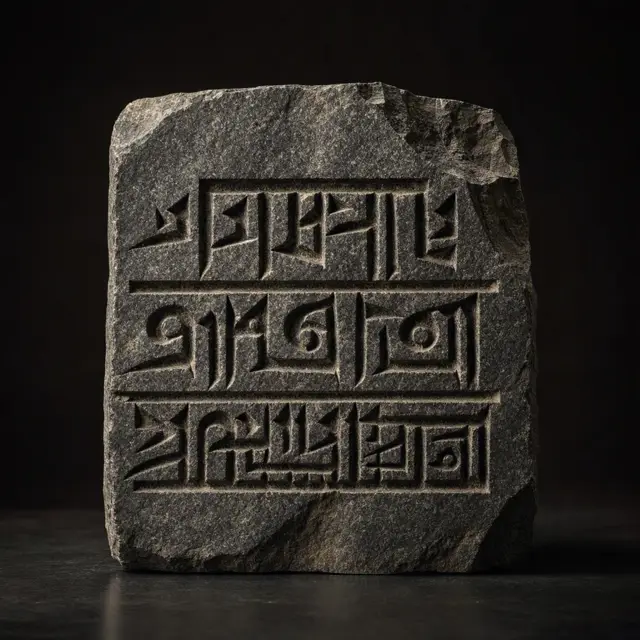
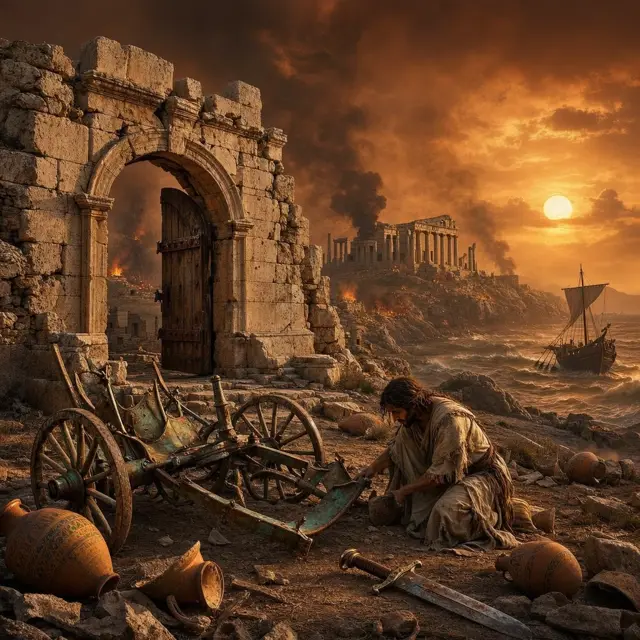
One of the eeriest clues comes from a clay tablet. As his kingdom of Ugarit crumbled, its king wrote a frantic letter: enemy ships were burning his cities, and every soldier and ship he had was already deployed elsewhere. His kingdom never sent another message. Archaeologists later found dozens of arrowheads scattered through Ugarit's ruins, proof of a violent assault rather than an accident.
Egyptian records blame roving raiders known as the Sea Peoples, a loose confederation whose exact homeland is still unknown. Pharaoh Ramesses III boasted of defeating them in battle, and carved reliefs show desperate sea fighting. But historians still argue whether the Sea Peoples caused the collapse or simply took advantage of a world that was already falling apart around them.
When the Sky Turned on Them
Nature may share the blame. Tree rings from ancient junipers point to a severe drought across Anatolia around 1198 to 1196 BC, right as the Hittite Empire buckled. Water levels in the Dead Sea dropped by more than 50 meters during this stretch, a sign of a long, punishing dry spell that could have wrecked harvests across the region.
Earthquakes piled on too. Mycenae had already been flattened once by a quake around 1250 BC, rebuilt, and then burned again decades later. Tiryns shows similar earthquake damage. Yet researchers caution that physical destruction alone cannot fully explain why entire societies never recovered. Drought and tremors likely weakened these kingdoms rather than delivering a single knockout blow.
A Machine Too Complicated to Fix
Some historians think the real killer was the system itself. Late Bronze Age kingdoms ran on tightly centralized palace economies that controlled trade, food storage, and even craft production from the top down. That made them efficient in good times, but brittle when trouble hit. A theory called systems collapse argues these societies had grown so specialized and interdependent that one disruption, a bad harvest, a cut trade route, a lost ally, could cascade into total failure.
Internal cracks made things worse. Some accounts point to peasant revolts and mercenaries switching sides once their pay stopped arriving. Meanwhile, the rise of ironworking meant larger armies could arm themselves with cheaper weapons, potentially overwhelming smaller, chariot-based forces that had dominated Bronze Age warfare for centuries.
What Rose From the Rubble
The fallout lasted centuries. Greece entered roughly 400 years of isolation and poverty now called the Greek Dark Age, during which writing itself vanished from the region until the Archaic period revived it. Meanwhile new groups reshuffled the map: Phrygians settled in Anatolia, Arameans moved into Syria, and Philistines resettled the Canaanite coast.
Not every kingdom fell. Assyria stayed remarkably stable, and the Phoenician city-states actually gained freedom and power once Egyptian and Assyrian control in the region weakened. Slowly, bronze gave way to iron across Europe, Asia, and Africa, ushering in the Iron Age.
Interestingly, modern research has softened the doom and gloom. One archaeologist re-examined destruction sites long blamed on this collapse and found over half were never actually destroyed at all, suggesting the story was messier, and less apocalyptic, than legend remembers it.