Paid for by Plunder
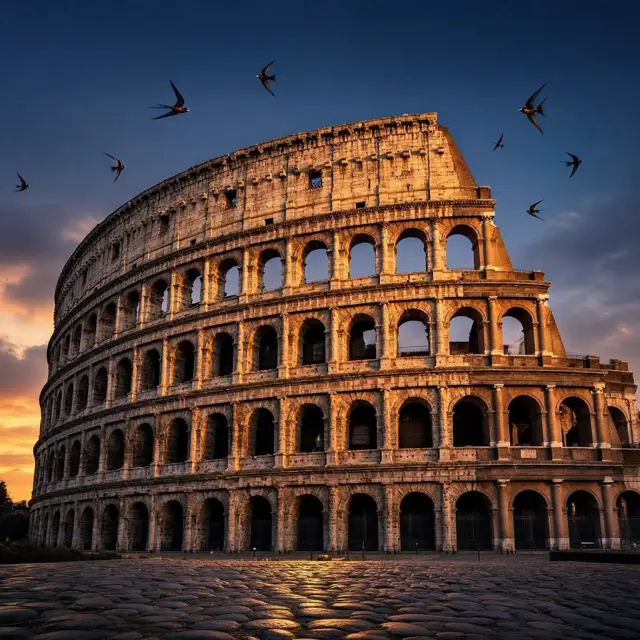
The Colosseum was a war trophy in building form. Emperor Vespasian began construction around AD 72, financing it with spoils taken from the Jewish Temple after the First Jewish-Roman War, and his son Titus completed the top level in AD 80, opening it with inaugural games. A third emperor, Domitian, made further modifications, which is why the family name stuck: officially it was the Flavian Amphitheatre.
So where did "Colosseum" come from? Not from the building at all, but from its neighbor: a colossal bronze statue of Nero that stood nearby. By the year 1000, the Latin name Colosseum had been coined for the arena from that adjacent Colossus.
It remains the largest ancient amphitheatre ever built and the largest standing amphitheatre in the world, planted in the heart of Rome just east of the Roman Forum.
An Arena Built Like a Modern Stadium
The numbers would impress a modern stadium architect. The oval measures 189 by 156 meters, its outer wall climbs 48 meters, and it held an estimated 50,000 to 80,000 spectators, with an average audience of about 65,000.
The materials were engineered for permanence: travertine limestone, tuff volcanic rock, and brick-faced Roman concrete. The outer wall alone consumed over 100,000 cubic meters of travertine, held together not by mortar but by 300 tons of iron clamps.
It even had a retractable roof of sorts. A great awning called the velarium could be drawn over the crowd to give shade, supported by 240 mast brackets around the top of the wall. Operating this rigging was a job for professionals: sailors, specially enlisted from the Roman naval headquarters at Misenum, worked the ropes above the arena.
Blood, Beasts, and Sea Battles
The entertainment menu was vast and often brutal: gladiator contests, animal hunts, executions, dramas drawn from Roman mythology, re-enactments of famous battles, and, briefly, even mock naval battles staged in the arena.
The animal hunts imported the whole empire's wildlife, with creatures such as rhinoceros, hippopotamuses, elephants, and giraffes facing hunters before the crowd. The record for excess belongs to Emperor Trajan, who allegedly staged contests involving 11,000 animals and 10,000 gladiators over the course of 123 days.
The magic happened below the floor. The hypogeum, a two-level underground network of tunnels and cages, hid animals and performers until their cue. Eighty vertical shafts connected it to the arena above, and elevators and pulleys lifted beasts and scenery into the daylight, letting a lion simply appear in the middle of the sand.
A Thousand Years of Second Careers
When the games ended in the early medieval era, the building refused to retire. Over the centuries it was reused as housing, workshops, quarters for a religious order, a fortress, a quarry, and a Christian shrine.
Time and greed did the damage the games never could. A great earthquake in 1349 collapsed part of the structure, and stone robbers hauled away its travertine for other buildings, leaving the broken profile we recognize today. A major restoration ran from 1993 to 2000, and since 2017 the top two levels have reopened for guided visits.
The ruin still commands the world's attention. It was listed among the New 7 Wonders of the World in 2007, the Pope leads a torchlit Good Friday procession that starts beside it, and every Italian 5 euro cent coin carries its portrait.