Built by Fifteen Thousand Hands
When Titanic entered service in 1912, she was the largest ship afloat anywhere on Earth. The ocean liner was built between 1909 and 1912 by the Harland and Wolff shipyard in Belfast at a cost of 1.5 million pounds, roughly 190 million pounds in 2024 money.
She measured 882 feet and 9 inches from bow to stern, and around 15,000 workers labored on her. The work was dangerous: 246 injuries and 8 deaths were recorded during construction.
Titanic was the second of three sister ships in the Olympic class, ordered by the White Star Line. The shipyard's chief naval architect, Thomas Andrews, poured his expertise into her design. In a grim twist of fate, he would sail on the maiden voyage and go down with his own creation.
A Floating Palace With a Fatal Math Problem
First class aboard Titanic was designed to be the pinnacle of luxury. Passengers enjoyed a gymnasium, a seven-foot-deep saltwater swimming pool, a Victorian-style Turkish bath, fine restaurants styled after the Ritz Hotel, and hundreds of opulent cabins. A high-powered radiotelegraph with a 350-mile range let passengers send messages from the middle of the ocean.
Safety looked equally impressive on paper. The hull was divided into 16 watertight compartments, with doors that could be closed automatically from a switch on the bridge. Features like these earned Titanic her reputation as "unsinkable".
The lifeboats told a different story. The ship carried 20 boats with room for 1,178 people, only about half of those aboard. Astonishingly, that was still generous by the rules of the day: British regulations required just 14 lifeboats for a ship her size, so Titanic actually carried six more than the law demanded.
Four Days Into the Maiden Voyage
Titanic left Southampton on 10 April 1912, called at Cherbourg in France and Queenstown in Ireland, then turned toward New York. She carried 2,208 passengers and crew, from some of the wealthiest people in the world to hundreds of emigrants seeking a new life in America.
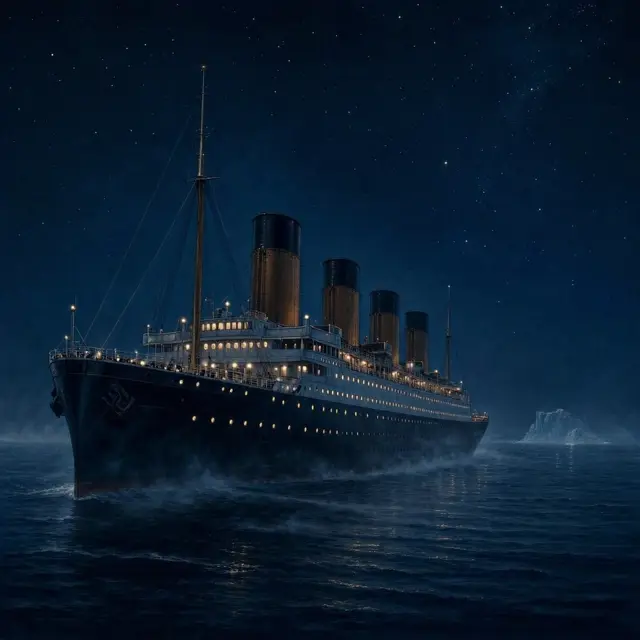
At 11:40 pm on 14 April, she struck an iceberg. In the early hours of 15 April, at 2:20 am, she sank. Approximately 1,500 people died, making it one of the deadliest peacetime sinkings of a single ship in history.
The tragedy was compounded by wasted seats: the lifeboats that got away were filled, on average, to only 60 percent of their capacity. Captain Edward John Smith went down with his ship. J. Bruce Ismay, the White Star Line's chairman, survived in a lifeboat, and first-class passengers survived at far higher rates than those in third class.
Two Miles Down
The disaster shocked the world into action. It spurred major reforms in maritime safety, including the SOLAS convention and the creation of the International Ice Patrol to watch the North Atlantic for icebergs.
The ship herself vanished for more than seven decades. In 1985, oceanographer Robert Ballard finally located the wreck resting about 12,500 feet below the surface of the Atlantic, a discovery that reignited global fascination with the story.
One last irony completes the tale. Titanic was not even the first White Star Line ship lost on her maiden voyage: the company had already lost RMS Tayleur the same way back in 1854. Between films, books, and exhibitions, the ship that sailed for less than a week has enjoyed a legacy in popular culture longer than almost any vessel that spent decades at sea.