A Broken Piece of Something Bigger
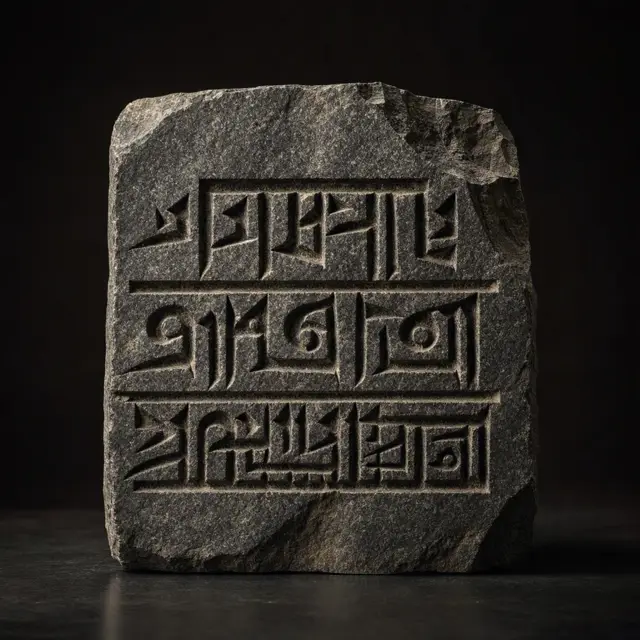
The Rosetta Stone is not an impressive object to look at. It is a slab of granodiorite — a hard, speckled grey rock — standing 112.3 cm high, 75.7 cm wide, and 28.4 cm thick, weighing around 760 kilograms.
More importantly, it is broken. What survives is a fragment of a much larger stele, an upright stone slab set up as a public monument. Fourteen or fifteen lines of hieroglyphic text are missing from the top, and scholars estimate the complete original stood about 149 centimetres tall.
What makes the surviving piece priceless is the redundancy carved into it. The same decree appears three times: in Egyptian hieroglyphs at the top, in Demotic script in the middle, and in Ancient Greek at the bottom. Scholars could already read Greek fluently. That made the bottom third a translation key for the two scripts nobody alive could read.
A Decree for a Thirteen-Year-Old King
The text itself is not poetry or prophecy. It is administration.
Issued at Memphis in 196 BC on behalf of Ptolemy V Epiphanes, the decree established the divine cult of the new ruler. It was the kind of document a priesthood produced to confirm a young king's standing and record the honours owed to him — bureaucratic, formulaic, and copied out for display in temples.
That ordinariness is precisely why it worked as a key. Because the decree was routine, its three versions differ only in minor details, so a scholar comparing them could line up phrases with real confidence. The stone was originally displayed inside a temple, possibly at Sais. Centuries later it was hauled off and reused as plain building material in the construction of Fort Julien, near the Nile Delta town of Rashid — the place Europeans called Rosetta.
Found by Accident, Taken by Treaty
In July 1799, during France's invasion of Egypt, a French army officer named Pierre-François Bouchard noticed the inscribed slab at Fort Julien. The discovery was announced to the Institut d'Égypte on 19 July. It was the first Ancient Egyptian bilingual text recovered in modern times, and European scholars grasped its significance almost immediately.
They did not get to keep it. When the British defeated the French, the stone changed hands under the terms of the Capitulation of Alexandria in 1801, and landed at Portsmouth in February 1802.
The British then did something startlingly blunt: they painted their claim directly onto the artefact. Inscriptions reading "Captured in Egypt by the British Army in 1801" and "Presented by King George III" were added to its sides, where they remain. Since June 1802 the stone has been exhibited almost continuously in the British Museum, and it is that museum's most-visited single object.
The Rings That Gave the Game Away
Cracking the script took more than two decades of grinding work by many people. The first complete translation of the Greek text was published in 1803. The real breakthroughs came in stages: recognising in 1799 that the stone carried three versions of one text; realising in 1802 that Demotic used phonetic characters to spell foreign names; then in 1814 that hieroglyphs did the same and closely resembled Demotic.
The decisive moment belongs to Jean-François Champollion, who announced his transliteration in Paris on 27 September 1822. His crucial insight involved cartouches — the oval rings drawn around certain groups of hieroglyphs. Those rings enclosed royal names, and names must be spelled out by sound in any language. Matching "Ptolemaios" from the Greek to the signs inside a cartouche gave him a set of phonetic values to build from.
Even then, confident reading of Egyptian literature took years more.