One Woman's Dance That Wouldn't Stop
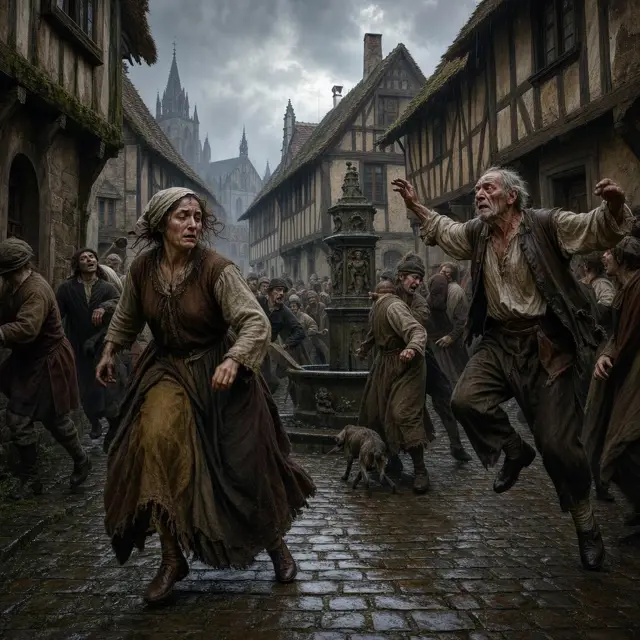
In July 1518, a woman named Frau Troffea stepped into a street in Strasbourg and began to dance. She didn't stop. According to accounts from the time, she kept dancing for about a week, pausing only to sleep before starting again the next morning.
Her performance drew a crowd, and the crowd didn't just watch. Within days, more than thirty people had joined her, including her own daughter. Nobody had asked them to dance, and nobody could make them stop. By August, estimates of how many people were swept into the frenzy range from 50 all the way up to 400.
The City's Cure Made Everything Worse
Strasbourg's leaders had a theory: if people were dancing uncontrollably, maybe the answer was to let them dance it out. City physicians agreed, so guild halls were cleared out and turned into makeshift dance floors. Musicians were hired to keep the rhythm going, and strong men were paid to hold up dancers who could barely stand.
The plan backfired almost immediately. Instead of tiring themselves out and returning to normal, more townspeople were drawn into the spectacle, and the dancing only spread further. Bodies gave out under the strain: dancers collapsed from exhaustion, hunger, and thirst, some suffering blood-swollen feet, and a few reportedly died of heart attacks mid-dance.
A Pilgrimage to Break the Curse
When dancing as a cure clearly wasn't working, the city council reversed course completely. Music and public dancing were banned outright. Instead, officials turned to religion, blaming the affliction on Saint Vitus, a saint believed to have the power to curse sinners with uncontrollable dancing — and to lift that curse too.
Afflicted dancers were bundled off on a pilgrimage to a shrine dedicated to Saint Vitus. They wore red shoes sprinkled with holy water and painted with crosses, carried small crosses of their own, and were led through incense and Latin prayers. By September, the remaining dancers were taken to a mountaintop chapel to pray, and the outbreak finally faded away. Survivors later said they felt forgiven by the saint.
Hysteria, Poison, or Divine Punishment?
Five centuries later, historians still argue about what really caused the dancing plague. The leading explanation, from historian John Waller, points to stress-induced mass hysteria: Alsace was gripped by famine and disease that year, and Waller argues the psychological strain pushed people into a trance-like state where they lost touch with their surroundings.
A competing theory blames ergot, a fungus that grows on rye and produces a chemical related to LSD. Waller rejects this idea, arguing that ergot poisoning couldn't keep dozens of people dancing in near-identical ways for days on end.
Nobody even agrees on how many people died. Some accounts claim roughly 15 deaths a day at the peak, which would add up to hundreds of deaths — but records from Strasbourg at the time mention no deaths whatsoever.