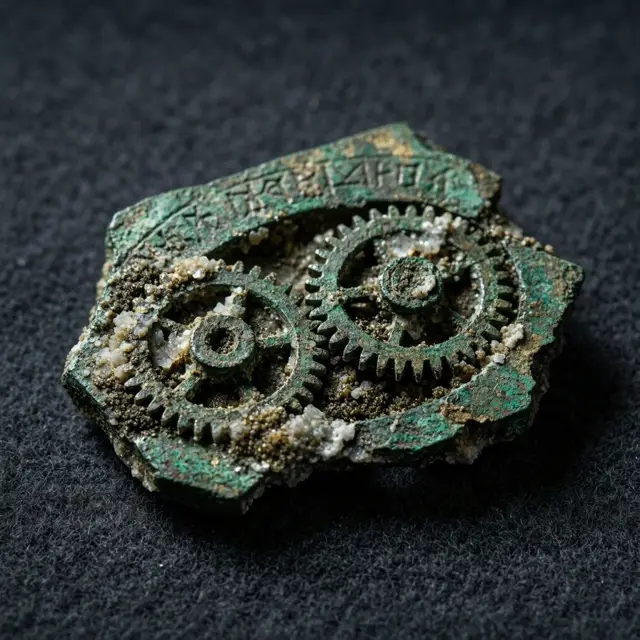
A Lump of Bronze Nobody Looked At
In 1901, wreckage was recovered from an ancient shipwreck off the Greek island of Antikythera. Among it was a corroded lump that attracted no particular attention.
A year later, in 1902, the Greek politician Spyridon Stais was visiting the National Archaeological Museum in Athens when he noticed something in that lump: a gear. He pointed it out to his cousin Valerios Stais, the museum director, and the first proper study began.
The object had been housed in the remains of a wooden-framed case measuring roughly 34 × 18 × 9 cm — shoebox scale. It came out of the sea as a single mass, later separated into three main fragments, which conservation work has since divided into 82 separate fragments. Four of those contain gears. Many of the others carry inscriptions. It is worth pausing on how nearly this was missed: the oldest known analogue computer sat in a museum, unremarked, until somebody happened to spot a cog.
Thirty-Five Gears and a Model of the Sky
The Antikythera mechanism is an ancient Greek hand-powered orrery — a mechanical model of the Solar System — built in the 2nd century BC. It is the oldest known analogue computer.
In 2005, a team from Cardiff University led by Mike Edmunds used X-ray tomography and high-resolution scanning to see inside the crust-encased fragments and read faint inscriptions that had once covered the outer casing. The scans indicated 35 meshing bronze gears, 30 of which are still visible. The largest gear is about 13 cm across and originally carried 223 teeth.
With those gears it could follow the Moon and Sun through the zodiac, predict eclipses decades in advance, and model the Moon's irregular orbit — accounting for the fact that the Moon travels faster at perigee, its closest point, than at apogee, its furthest. That irregularity was studied in the 2nd century BC by the astronomer Hipparchus of Rhodes, who may even have been consulted on the machine's construction.
It Also Tracked the Olympics
For a device built to model the heavens, one of its functions is charmingly human. Alongside eclipse prediction and planetary positions, the mechanism tracked the four-year cycle of athletic games similar to an olympiad — the cycle of the ancient Olympic Games.
That single feature reframes what the object was for. This was not a pure astronomical instrument locked away in a scholar's study. It was a calendar device for organising civic and religious life, where knowing when the games fell mattered as much as knowing when the Moon would darken.
The inscriptions kept giving up more. Further decipherment in 2016 revealed numbers connected with the synodic cycles of Venus and Saturn. There is ongoing speculation that a missing portion of the mechanism calculated the positions of all five classical planets — meaning the surviving fragments may represent only part of what the machine could actually do.
Fourteen Hundred Years of Nothing Like It
Dating the mechanism has produced a range rather than a date. It has been variously placed at about 87 BC, between 150 and 100 BC, or 205 BC. What is certain is that it predates the shipwreck, which multiple lines of evidence date to roughly 70–60 BC.
In 2022, researchers proposed 23 December 178 BC as its initial calibration date — not the date it was built, but the date it was set running. Other experts favour 204 BC for that calibration.
Then comes the fact that unsettles historians of technology. Machines of comparable complexity did not appear again until the 14th century in western Europe — well over a millennium later. The knowledge required to build this did not accumulate steadily; it existed, and then it was lost. All the fragments are kept at the National Archaeological Museum in Athens today, displayed alongside reconstructions and replicas that show how it may have looked and worked.