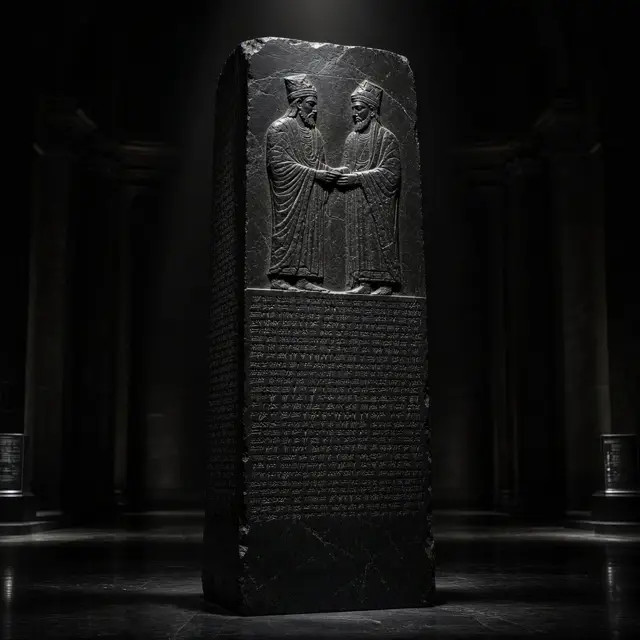
Carved on a Pillar of Stone
The Code of Hammurabi is a Babylonian legal text composed around 1753 BC in the Old Babylonian dialect of Akkadian. It is the longest, best organised and best preserved legal text from the ancient Near East.
The main copy is carved on a basalt stele 2.25 metres tall. At the top is a carved relief scene featuring Hammurabi himself. Below it run about 4,130 lines of cuneiform. One fifth is a prologue and epilogue in a poetic style, and the other four fifths are the laws themselves.
Someone tampered with it long ago. Near the bottom, seven columns of laws, each over eighty lines, were polished away in antiquity, most likely so a later ruler could carve his own inscription there.
Hammurabi was the sixth king of the First Dynasty of Babylon and ruled from about 1792 to 1750 BC. He expanded Babylon's power through war, diplomacy and betrayal of allies, yet his surviving letters show a real interest in law and in the welfare of his subjects.
Plundered, Buried, Rediscovered
The stele was not found in Babylon. A French archaeological mission dug it up between December 1901 and January 1902 at Susa, an ancient Elamite city in what is now Khuzestan Province in Iran.
It got there as loot. An Elamite king is thought to have carried it off roughly 600 years after it was made, and to have ordered those columns of law erased so his own account could replace them. One scholar suggests it was taken from Sippar, where Hammurabi lived towards the end of his reign.
It came out of the ground in three large fragments, which made reassembly straightforward. The reconstructed stele now stands in the Louvre in Paris.
The text itself never really disappeared. Mesopotamian scribes copied and studied it for more than a thousand years, which is why some laws missing from the damaged stele can be restored from other surviving copies.
If This, Then That
The laws are casuistic, meaning each is written as a conditional sentence: if a particular thing happens, then this follows. They cover a wide range, including criminal matters, family, property and commerce.
One principle running underneath is lex talionis, the idea of an eye for an eye. Laws 196 and 200 prescribe exactly that for an eye and a tooth. The principle could also be applied harshly across generations, since a punishment might fall on a wrongdoer's son rather than the wrongdoer.
People were not equal before this law. The text names three broad categories of person, and class, gender and profession all shaped the penalty or the compensation. The differences were not simple: a commoner's life might be valued lower, but so were some of his fines.
The Code also reached into the economy. It fixed prices for goods, capped interest at 20 percent, and set minimum wages, with higher rates for seasonal work.
Parts That Sound Familiar
Much of the Code feels distant from modern legal systems, but not all of it.
The first two laws deal with accusations that cannot be substantiated, and punish the accuser. That is close to a presumption of innocence. Written evidence was treated as highly valuable, especially in matters of contract. A single crime carried a single punishment, and the intentions of the accused were taken into account.
The decision to carve the laws on public stone monuments may itself have been an attempt at access to justice. The text suggests that a wronged man should have the stele read aloud to him, which is a practical measure in a society where almost nobody could read.
When the Code was rediscovered, scholars were struck by its apparent fairness and by the complexity of the society behind it. They also noticed the eye for an eye principle shared with the Mosaic law, which set off a long discussion about influence between the two.