The Big Ditch Everyone Mocked
In 1800, travelling overland from New York to Cleveland took about two and a half weeks. The Appalachian Mountains stood in the way, with only five places where mule trains or wagon roads could cross. Farmers out west often found their grain was not even worth the cost of hauling it to the coast.
A canal across New York looked like the answer, but there was a catch. The land rises about 600 feet (180 m) from the Hudson River to Lake Erie. President Thomas Jefferson called the idea 'little short of madness' and rejected it. One of its biggest fans, Jesse Hawley, started pushing for the canal while sitting in a debtors' prison, after going bankrupt trying to ship grain to the coast.
Hawley won over New York Governor DeWitt Clinton. Opponents mocked the project as 'Clinton's Folly' and 'Clinton's Big Ditch'. In 1817 the state legislature approved $7 million for it anyway, and the digging began.
Built by Beginners
Here is the wild part: there were no civil engineers in the United States. The men who laid out the route, James Geddes and Benjamin Wright, were judges whose surveying experience came from settling boundary disputes. Geddes had used a surveying instrument for only a few hours before starting. Canvass White was a 27-year-old amateur who paid his own way to Britain to study canals. Nathan Roberts was a math teacher.
Work began on July 4, 1817, at Rome, New York. Early progress was painfully slow, so the crews got inventive. To rip out tree stumps, they built a puller with two huge wheels and a smaller middle wheel, turned by a team of oxen. To move earth, animals dragged a 'slip scraper', similar to a bulldozer. Leaks were later sealed with hydraulic cement.
These beginners became a skilled workforce as they went. In the end, all of their bold designs worked exactly as planned.
Climbing a Cliff With Water
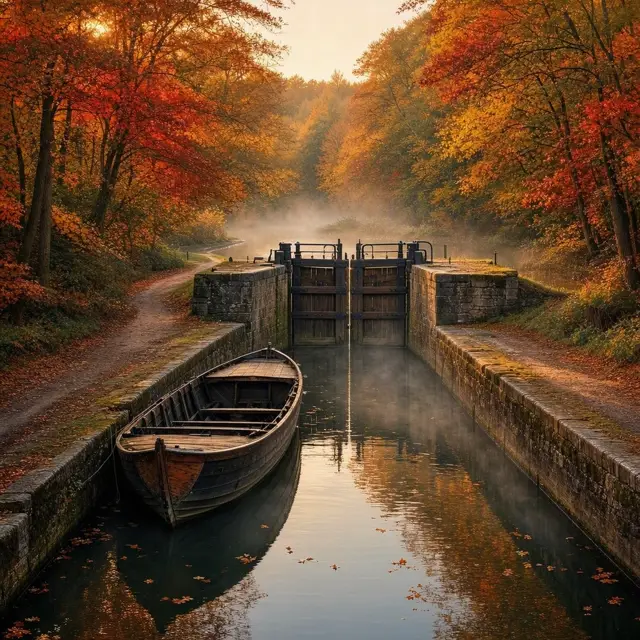
The canal had to lift boats over real obstacles. The tool for that was the lock. Locks back then could lift a boat about 12 feet (3.7 m), so the planners figured about fifty would be needed along the route.
The toughest spot was the Niagara Escarpment, an 80-foot (24 m) wall of hard limestone. Builders lined up two sets of five locks along a 3-mile (4.8 km) stretch. A whole community grew up around them, and it took the fitting name Lockport.
Rivers and valleys were another headache. Near Rochester, the canal crossed the Genesee River on a stone aqueduct 802 feet (244 m) long, held up by 11 arches. To get past Irondequoit Creek, workers built the 'Great Embankment', which carried the canal 76 feet (23 m) above the creek, while the creek itself ran through a long tunnel-like culvert underneath. The final stretch had to be blasted 30 feet (9.1 m) deep through another ridge of limestone.
The Wedding of the Waters
The canal officially opened on October 26, 1825, and New York threw a statewide 'Grand Celebration'. Cannons placed along the canal and the Hudson fired one after another, passing the news from Buffalo to New York City in a 90-minute chain of booms.
Governor Clinton then sailed from Buffalo to New York City aboard the boat Seneca Chief, a ten-day trip. At the end, he poured Lake Erie water into New York Harbor to mark the 'Wedding of the Waters'. On the way back, the boat carried a keg of Atlantic Ocean water, which was poured into Lake Erie.
The 'folly' was an instant hit: tolls paid off the state's whole construction debt within the first year. Shipping a barrel of flour from Rochester to Albany dropped from $3 to 75 cents. New York came to be called the 'Empire State'. Buffalo grew from 200 settlers in 1820 to over 18,000 people by 1840.
Mule Power and Floating Living Rooms
Canals worked because water makes heavy loads easy. A mule can carry only about 250 pounds (110 kg) on its back, but it can pull a 60,000-pound (27,000 kg) barge along a towpath. Overall, a canal could cut transport costs by about 95 percent.
The drivers were called 'hoggees'. When two boats met, one team stopped, its towline went slack and sank to the bottom, and the other boat's horses simply stepped over it without stopping.
Passengers rode in 'packet boats' at up to five miles per hour. The best ones had carpets, stuffed chairs and shelves of books. At night, beds folded down from the walls, and some captains even hired musicians. In 1825 alone, more than 40,000 passengers rode the canal, while vendors hopped from boat to boat selling books, watches and fruit. Life on the water inspired many songs, including 'Low Bridge, Everybody Down', written in 1905 to remember the days when mules, not engines, pulled the barges.