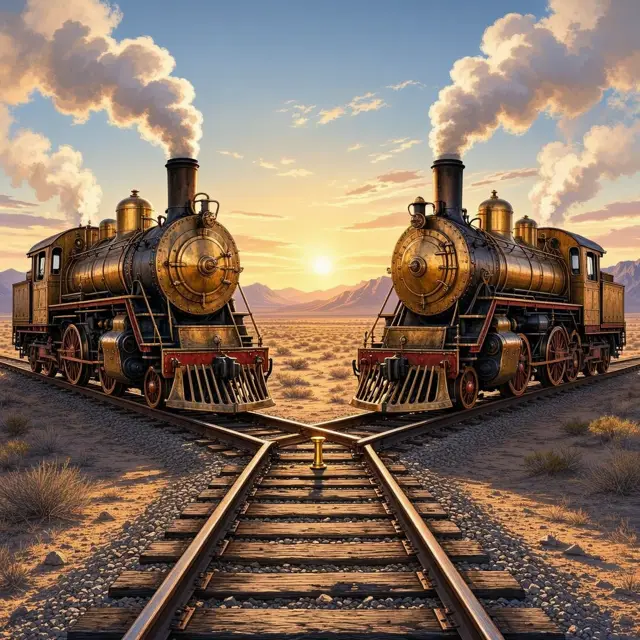
The Swing Heard Across a Nation
On May 10, 1869, two locomotives stood nose to nose at Promontory Summit in Utah Territory. One was the Central Pacific's Jupiter, which had come from the west. The other was Union Pacific No. 119, from the east. Between them, Leland Stanford tapped the gold "Last Spike" with a silver hammer.
It was perhaps the world's first live mass-media event. The hammer and spike were wired to the telegraph line, so each blow would be heard as a click at stations across the country. But the hammer strokes missed. So the telegraph operator simply sent the clicks himself.
Once the golden spike was swapped for an ordinary iron one, a single word went out to both coasts: "DONE". The line ran 1,911 miles in total. The golden spike now sits at the Cantor Arts Center at Stanford University. A second "Last" golden spike is on display at the California State Railroad Museum in Sacramento.
A Race Paid by the Mile
Two companies built the main line toward each other. The Central Pacific started in Sacramento, California, and built 690 miles east. The Union Pacific started at Omaha, Nebraska, and built 1,085 miles west. A third company added the last stretch to San Francisco Bay.
The government paid them by the mile, using bonds. Track on flat land earned $16,000 a mile. Foothills earned $32,000, and mountains earned $48,000. That gave both sides a reason to lay track fast.
The Central Pacific broke ground on January 8, 1863, but it had a strange problem. There were no good routes from the factories in the east. So rails, switches and even whole locomotives were shipped by sea, either around Cape Horn or across Panama. Many engines arrived taken apart and had to be rebuilt. The Union Pacific did not start until July 1865, delayed by the Civil War and a lack of money and workers.
Blasting Through the Sierra Nevada
The hardest part was the Sierra Nevada mountains. To cut a tunnel, one worker held a rock drill against the granite. One or two others swung 18-pound sledgehammers to drive it in. When the hole was about 10 inches deep, they filled it with black powder and lit a fuse from a safe distance.
The Central Pacific also used a newer explosive, nitroglycerin. It even ran its own plant to make it. Crews dug 15 tunnels, about 32 feet high. To speed up, they dug vertical shafts so they could work four tunnel faces at once. Even so, progress could be under one foot per face each day.
Snow was another enemy. Starting in 1867, crews built 37 miles of wooden snow sheds to protect the track from avalanches. Some galleries had sloped roofs so avalanches would slide right over them. The builders also chose what is now called standard gauge, the track width most northern railways already used.
The People Who Built It
The Central Pacific struggled to find enough workers in California, where most men preferred mining or farming. In 1865 it ran an ad for 5,000 laborers. It then tried hiring Chinese immigrants. They proved so good at the work that the company preferred to hire Chinese workers from then on, and even recruited in China.
Chinese workers did most of the heavy manual labor, because animals and machines could do only a little of it. They were first paid $31 a month, and after a strike in 1867 the wage rose to $35. They drank boiled water and had less dysentery than other workers. The Union Pacific hired many former soldiers from both Civil War armies, along with Irish immigrants.
The pace could be amazing. On April 28, 1869, Central Pacific crews laid 10 miles and 56 feet of track in one day, a record. At Promontory, the last two rails on the Union Pacific side were laid by Irish workers, and on the Central Pacific side by Chinese workers.
From Six Months to One Week
The railroad shrank the country. Travel from coast to coast dropped from six months or more to about one week. It cost one tenth as much as a stagecoach or wagon. Before the railroad, shipping corn 200 miles by wagon could cost more than the corn was worth.
Things only got faster. In 1876, the Transcontinental Express reached San Francisco just 83 hours and 39 minutes after leaving New York City. Back then, time was not even standard across the country. Each railroad set its own clock until November 18, 1883.
People had once thought the vast western lands would take 300 years to settle. With the railroad, it took about 30. Hundreds of miles of the old line are still in use today. At the Golden Spike National Historical Park, replicas of Jupiter and No. 119 still face each other, and the park fires them up for visitors. Utah even put the spike on its state quarter.