Older Than Farming, Writing or the Wheel
Göbekli Tepe is a Neolithic site in Upper Mesopotamia, in modern-day Turkey, whose name means Potbelly Hill. It was inhabited from around 9500 BCE to at least 8000 BCE, during the Pre-Pottery Neolithic.
The dates are the whole story. Its large circular structures hold stone pillars that are the oldest known megaliths in the world, raised by people who had no pottery, no metal, no writing and no wheel. The 15 m high, 8 hectare tell is covered with domestic structures, small buildings, quarries and stone-cut cisterns.
UNESCO designated it a World Heritage Site in 2018, recognising it as "one of the first manifestations of human-made monumental architecture". The most tantalising detail is how much is still buried. As of 2021, only around 10% of the site had been excavated, while geophysical surveys indicate the mound contains at least 20 large enclosures.
Headless Giants Ringed by Animals
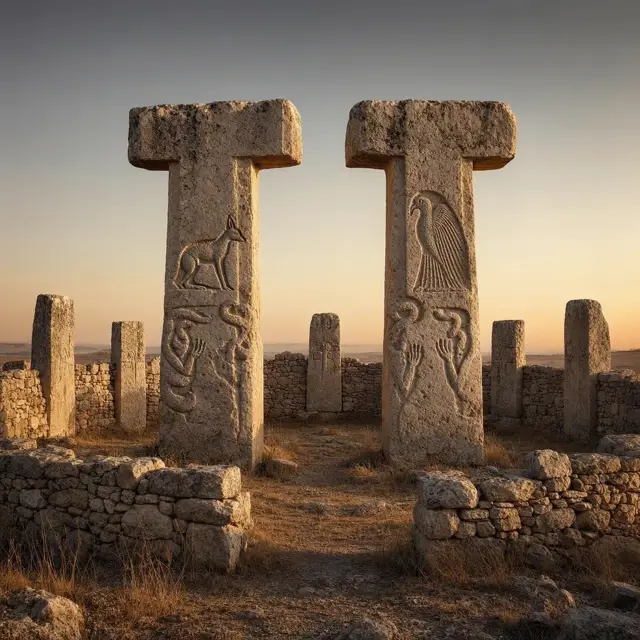
The first circular compounds appear in the latter half of the 10th millennium BCE, ranging from 10 to 30 m across. Their defining feature is the T-shaped limestone pillars set evenly into thick interior walls of unworked stone, with two taller pillars standing face to face at the centre of each circle and stone benches for sitting around the inside.
Four such structures have been unearthed. Surveys suggest 16 more, enclosing up to eight pillars each, which would amount to nearly 200 pillars in total.
Many are carved. The reliefs show lions, bulls, boars, foxes, gazelle and donkeys, snakes and other reptiles, insects and arachnids, and birds, with vultures especially prominent, as they also are at Çatalhöyük and Jericho. Very few clearly human figures appear. Some pillars have human arms carved on their lower half and loincloths below, which suggested to excavator Klaus Schmidt that the pillars themselves are stylised human bodies, with the horizontal slab on top standing in for shoulders, leaving the figures headless.
The Argument Over Who Built It
The slabs were cut from bedrock pits about 100 m from the hilltop, with workers using flint points to work through the limestone. How many people that took is genuinely disputed, and the answer changes what the site means.
Schmidt argued the work of quarrying, transporting and erecting tons of well-prepared limestone pillars "was not within the capability of a few people". Drawing on Thor Heyerdahl's experiments with the moai of Rapa Nui, he estimated one comparable statue would take 20 people a year to carve and 50 to 75 people a week to move 15 km, and cited a 1917 account of a megalith on the Indonesian island of Nias built by 525 people in three days.
Others put it far lower, estimating that just 7 to 14 people could have moved the pillars using ropes and water or another lubricant, along the lines of techniques proposed for Stonehenge. Schmidt's higher figures underpinned his interpretation of a large, non-resident workforce coerced or enticed there by a small religious elite.
Not a Temple in an Empty Landscape
Göbekli Tepe is popularly described as the world's first temple, but no definitive purpose has actually been established for the megalithic structures.
That popular framing is also getting harder to defend. Recent findings point to a genuine settlement: domestic structures, extensive cereal processing, a water supply and tools associated with daily life. This contrasts with the earlier interpretation of a sanctuary visited by nomads with few or no permanent inhabitants. The inhabitants appear to have been hunter-gatherers who supplemented their diet with early domesticated cereal and lived here for at least part of the year, with archaeozoological evidence pointing to large-scale hunting of gazelle between midsummer and autumn.
They engineered for it, too. The village collected drinking water through a rainwater harvesting system of carved channels feeding cisterns cut into the bedrock, which could hold at least 150 cubic metres. This was not a place people simply visited.
Buried on Purpose, and Nobody Knows Why
The strangest fact about Göbekli Tepe is what its builders kept doing to it. Every few decades, the existing pillars were buried and replaced with new stones forming a smaller concentric ring inside the older one. There is no accepted explanation for this.
The structures had a difficult life in general. They were likely roofed, and appear to have repeatedly collapsed, been inundated by landslides, and then been repaired or rebuilt. In 2017 fragments of human crania with deliberate incisions were found at the site, interpreted as a local expression of the widespread Neolithic skull cult also known from Jericho, Tell Aswad and Çatalhöyük.
Modern attention came late. The site was first noted in an archaeological survey in 1963 and largely overlooked. Klaus Schmidt recognised its significance in 1994 and began excavating the following year. After he died in 2014 the work continued as a joint project of Istanbul University, the Şanlıurfa Museum and the German Archaeological Institute, directed by the Turkish prehistorian Necmi Karul.