Why the Oceans Filled With Pirates
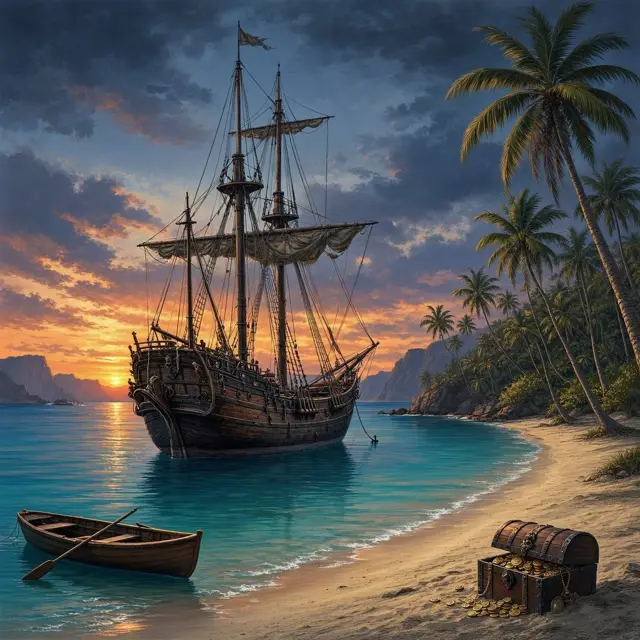
The Golden Age of Piracy ran roughly from the 1650s to the 1730s, when pirates were a real force across the Atlantic and Indian Oceans. Almost everything people picture about pirates today comes from this period, though not always accurately.
The conditions were perfect. Huge amounts of valuable cargo were being shipped across vast oceans to Europe. Navies were stretched thin in some regions. Many sailors had trained in European navies and knew how to fight. And colonial governments were often weak or corrupt.
Many pirates started out as a privateer, a private sailor given official permission in wartime to attack enemy ships. When wars ended, thousands of them were suddenly out of work. After the peace treaties of 1713 and 1714, many simply kept attacking ships, just without permission.
Life on ordinary ships pushed others into it. Merchant sailors often faced low pay and terrible conditions, and many came to prefer the freer life of a pirate.
Three Waves of Plunder
Historians often split the age into three periods. The first was the buccaneer period, roughly 1650 to 1680, when English and French sailors based in the Caribbean raided Spanish colonies and ships. The most famous was Henry Morgan, who captured Panama City and burned it. Instead of being executed, he was knighted and made governor of Jamaica.
The second, in the 1690s, was the Pirate Round. Pirates sailed from the Caribbean and North America all the way to the Indian Ocean and the Red Sea, where rich ships carried silk and fine cloth and no strong navies patrolled. Henry Every captured one of the richest ships of all in 1695, and was one of the few major pirates to retire with his loot.
The third wave came after 1715. Pirates set up a base at Nassau in the Bahamas, later known as the Republic of Pirates. Among them was Edward Teach, better known as Blackbeard, whose most famous ship was the Queen Anne's Revenge.
Rules, Tricks and Female Pirates
Pirate ships could be surprisingly fair. Outside of battle, crew members often had as much say as the captain. The captain only had full command during a fight, and could be removed if he showed cowardice.
Pirates also lived by a pirate code, a set of agreed rules. One common rule said every pirate had to clean and look after his own weapons, or face punishment.
In battle, their favourite weapon was fear. Raising the pirate flag and firing a warning shot was often enough to make a ship give up without a fight. Sam Bellamy once ordered his men to strip naked before attacking a French ship, and the sight alone made its crew surrender. When a ship did fight back, pirates fired chain shot at its masts to leave it stranded.
The age also produced more than 40 female pirates. The most famous, Anne Bonny and Mary Read, sailed in John Rackham's crew. When they were captured in 1720, both avoided execution by saying they were pregnant.
Eyepatches, Earrings and the End
Eventually the hunters became the hunted. In 1718, Governor Woodes Rogers arrived in Nassau with the power to pardon pirates. Some took the deal and even became pirate hunters themselves. Blackbeard was killed that same year. Historians often mark the end of the age with the deaths of Bartholomew Roberts in 1722, William Fly in 1726 and Olivier Levasseur in 1730.
Roberts is considered by many to be the most successful Western pirate of all time, with more than 400 ships captured.
Much of our pirate image comes from a 1724 book, A General History of the Pirates, by a Captain Charles Johnson. One historian said the book created the modern idea of pirates, though its accuracy is doubtful. It went on to influence writers like Robert Louis Stevenson.
Some details are real. Pirates did wear gold and silver earrings, partly hoping the metal would pay for a decent burial. But the eyepatch is mostly a myth from 19th-century novels. Few real pirates ever wore one.