A Glass Palace Built in Nine Months
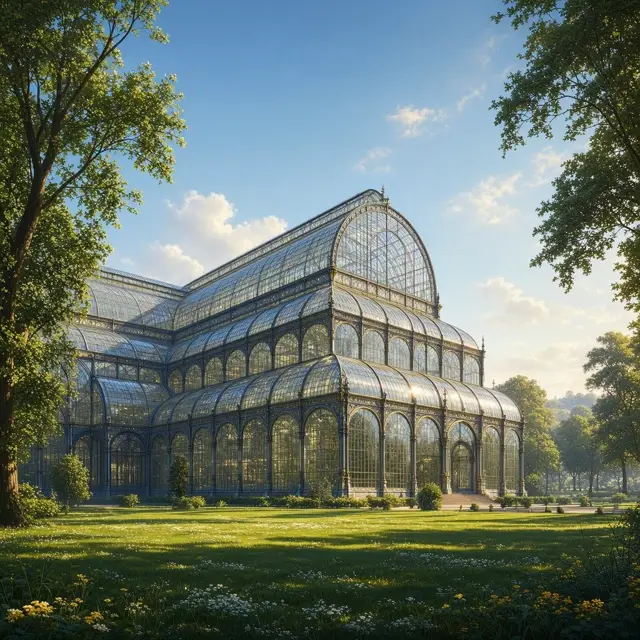
In 1851, London built a giant greenhouse and filled it with the world's inventions. The Great Exhibition ran in Hyde Park from 1 May to 15 October, and its home became known as the Crystal Palace.
The building came from Joseph Paxton, who had designed greenhouses for the sixth Duke of Devonshire. He worked with structural engineer Charles Fox, and Isambard Kingdom Brunel sat on the committee overseeing the build. From planning to grand opening took just nine months.
It was a massive glass house, about 563 metres long and 138 metres wide. It was made from cast iron frame parts and glass, nearly all produced in Birmingham and Smethwick. Inside, trees and statues made the huge space feel even bigger. People hailed it as an architectural marvel and an engineering triumph. In 1854 it was moved and rebuilt, even larger, at Sydenham Hill in south London, an area later renamed Crystal Palace.
Six Million Visitors and a Penny Toilet
Six million people visited the Great Exhibition. That was equal to a third of the whole population of England and Wales at the time. On an average day 42,831 people came, and the busiest day, 7 October, drew 109,915.
Ticket prices dropped as the season went on. A season ticket cost two guineas, or three for a man. The first two days cost £1, then five shillings, and later just one shilling. That one-shilling ticket was a hit with working people. Railways offered cheap fares from distant towns, and Thomas Cook arranged travel for 150,000 people. Those too poor to travel lined up by the tracks to watch the long trains go past.
One exhibit was a true crowd-pleaser. George Jennings installed the first modern public flush toilets, and 827,280 visitors paid a penny to use them. Spending a penny became a euphemism for using a toilet. They were so popular that the first public lavatories opened in 1852.
Diamonds, Leeches and an Early Fax Machine
About 13,000 exhibits filled the hall, from Britain, its colonies and 44 foreign states. Visitors could watch cotton go from spinning to finished cloth. There was a Jacquard loom, an envelope machine, kitchen appliances, and a reaping machine sent from the United States.
Some displays were dazzling. The Koh-i-Noor, meaning Mountain of Light, was then the world's largest known diamond and one of the most popular sights. Others were plain odd. The Tempest prognosticator was a barometer that used leeches.
Inventors showed off ideas ahead of their time. Frederick Bakewell demonstrated an early form of the fax machine. William Chamberlin Jr. showed what may have been the world's first voting machine, which counted votes automatically. Alfred Charles Hobbs used the event to show that several respected door locks were not good enough. C.C. Hornung of Copenhagen showed the first single-cast iron piano frame made in Europe, and Mathew Brady won a medal for his daguerreotypes.
Why Britain Threw the Party
The show was organised by Henry Cole and Prince Albert, Queen Victoria's husband, with members of the Royal Society of Arts. It was partly a reply to a highly successful French industrial show in 1844, and Britain's main aim was to make clear to the world its role as industrial leader. It became the first of the world's fairs, big shows of culture and industry that caught on in the 19th century.
The show paid its own way, with committees across the country collecting donations from ordinary citizens. Queen Victoria came three times with her family and 34 times on her own.
The guest list reads like a history book. Charles Darwin, Michael Faraday, Charlotte Brontë, Charles Dickens, Lewis Carroll and George Eliot all attended. Not everyone was a fan: a teenage William Morris later said he refused to go on grounds of taste. The first international chess tournament was held there, and the America's Cup sailing race began alongside it.
The Profit That Built Museums
The exhibition made a surplus of £186,000, thanks mostly to ordinary visitors paying at the door. That money founded the Victoria and Albert Museum, the Science Museum and the Natural History Museum. They were built just south of the exhibition site, in an area nicknamed Albertopolis. The rest set up an educational trust that gives grants and scholarships for industrial research, and it still does so today.
Visitors also wanted to take the show home. Makers sold stereoscope cards, hand-coloured printed cards that gave a three-dimensional view of the event. Peering through small peep holes, people could relive their visit in miniature.
Today the Great Exhibition is a symbol of the Victorian Age. The Albert Memorial, behind the Royal Albert Hall, is inscribed with its statistics, including the number of visitors and exhibitors and the profit made. The Crystal Palace itself was destroyed by fire on 30 November 1936.