The Only Wonder Left
The Great Pyramid of Giza is the largest of the Egyptian pyramids and the most famous landmark of the Giza pyramid complex. It is the oldest of the Seven Wonders of the Ancient World — and the only one that has remained largely intact.
Every other wonder on that list is gone. This one is still standing, and it was already the oldest of them when the list was drawn up.
It served as the tomb of the Pharaoh Khufu ("Cheops"), who ruled during the Fourth Dynasty of the Old Kingdom. It was built around 2600 BC, over a period of about 26 years. Hemiunu, Khufu's vizier, is believed by some to have been its architect — though many competing scientific and alternative hypotheses attempt to explain the exact construction techniques, and, as with other such structures, there is no definite consensus.
Tallest for Thirty-Seven Centuries
The Great Pyramid initially stood 146.6 metres tall, and it remained the world's tallest human-made structure for more than 3,700 years.
That record is almost impossible to comprehend. Empires rose and vanished, entire writing systems were invented and forgotten, and for over three and a half millennia nobody built anything taller.
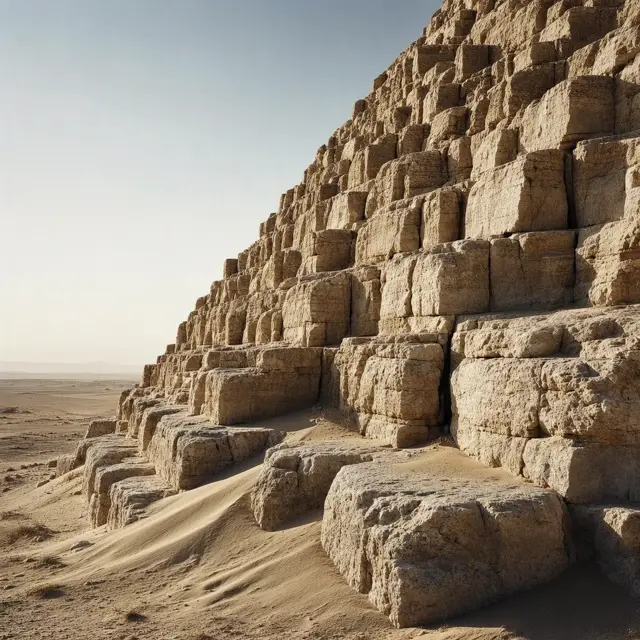
What stands today is not quite the original. Most of the smooth white limestone casing was removed over the centuries, lowering the height to the current 138.5 metres — meaning the rough, stepped structure everyone photographs is the core, the inside of a monument that was once sheathed in polished white stone. Each side of the base measures about 230.3 metres, and the whole thing encloses roughly 2.6 million cubic metres, which includes an internal hillock of natural rock. In the original units it was 280 royal cubits high with a base of 440 cubits, at a slope of 51°50'40".
Six Million Tonnes, Moved by Hand
The pyramid was built by quarrying an estimated 2.3 million large blocks, weighing 6 million tonnes in total.
The blocks are less uniform than the finished silhouette suggests: most are not consistent in size or shape and are only roughly dressed, bound together at the outer layers with mortar. The bulk of the stone was local limestone from the Giza Plateau.
The special materials came by water. White limestone from Tura was imported by boat on the Nile for the casing, and blocks of granite from Aswan — weighing up to 80 tonnes each — were shipped for the structure of the King's Chamber. An 80-tonne stone floated hundreds of kilometres downriver, landed, dragged into place, and lifted dozens of metres into the air, using no machine anyone today can point to with certainty.
Three Chambers and Five Buried Boats
There are three known chambers inside. The lowest was cut into the bedrock the pyramid stands on, and was left unfinished. Above ground, within the structure itself, sit the so-called Queen's Chamber and the King's Chamber, the latter containing a granite sarcophagus.
The pyramid was never meant to stand alone. Its funerary complex included two mortuary temples joined by a causeway — one near the pyramid, one near the Nile — along with tombs for Khufu's immediate family and court.
That complex included three smaller pyramids for Khufu's wives, an even smaller satellite pyramid, and five buried solar barques: full boats, interred alongside the tomb. The whole site forms part of the UNESCO World Heritage Site "Memphis and its Necropolis".