A Trade Giant With No Boss and No Birthday
At its peak, the Hanseatic League linked nearly 200 settlements across eight modern countries, from Estonia and Russia to the Netherlands, and inland as far south as Cologne. It dominated sea trade in the North and Baltic Seas. Yet it had no permanent government, no treasury and no standing military force.
It was never formally founded, so it has no birthday. Historians long pointed to the rebuilding of Lübeck in 1159, but newer research sees Lübeck as just one of several trading centers. The name comes from Hansa, an Old High German word for a band or troop. The popular claim that it once meant on the sea is wrong.
Big decisions were made at an irregular meeting called the Hanseatic Diet. Consensus there simply meant that nobody protested. People who backed an idea with little chance of winning just stayed silent, and the rest was written down as binding.
Little Merchant Towns Inside Foreign Cities
The league's secret weapon was the kontor, a trading post in a foreign city. The big four were in London, Bruges, Bergen and Novgorod. Each ran as a private corporation with its own treasury, court, rules and seal. Kontors checked the quality of goods, gathered news and worked like an early stock exchange. Their rules were read aloud to the merchants once a year.
London's kontor, the Steelyard, stood west of London Bridge, on the site later taken by Cannon Street station. It grew into a walled community with warehouses, a weigh house, offices and homes. After it burned in the Great Fire of London in 1666, a plea for rebuilding money led to a meeting in 1669. Nobody knew it would be the league's last formal meeting.
The Bergen kontor kept going until 1754. Its buildings, known as Bryggen, are the only kontor buildings that survive today.
Herring, Furs, Salt and Wax
Hanseatic ships moved the everyday goods of medieval Europe. From the east came beeswax, furs, timber, tar, flax, honey, wheat and rye. Going the other way were cloth, especially broadcloth, and more and more manufactured goods. Copper, iron and herring came south from Sweden.
Lübeck became a transshipment port between the North Sea and the Baltic, and it played a vital role in salt. Salt came from Lüneburg, France and Portugal, and much of it went to Scania to salt herring, where around 30 seasonal Hanseatic stations worked. In Bergen, merchants traded grain for stockfish, and that grain let people settle more permanently further north in Norway.
The trade language, Middle Low German, left a strong mark on Scandinavian languages, Estonian and Latvian.
Cogs, Hulks and a 78 Metre Giant
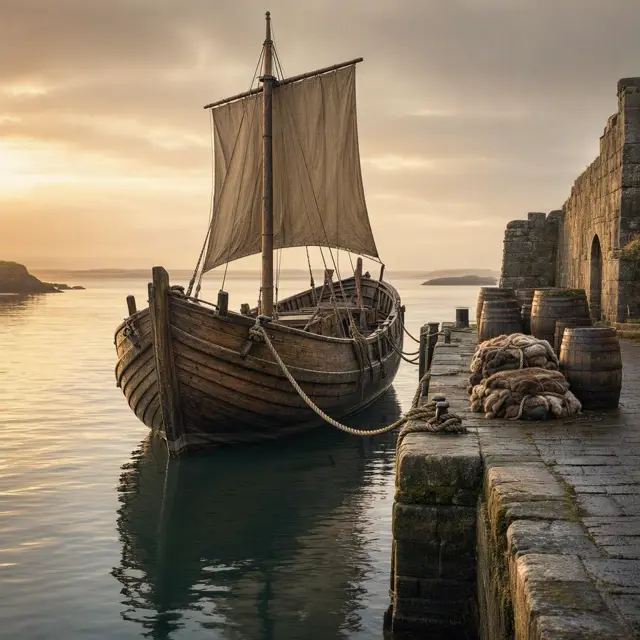
The league's signature ship was the cog. It had one square-rigged mast and a rudder at the stern, and it sailed both seas and rivers. Cogs appeared on the seals and coats of arms of cities like Stralsund and Wismar. The most notable wreck, the Bremen cog, could carry about 125 tons.
By around 1450, the cog had lost out to the hulk, which could carry up to 500 tons. Oddly, no archaeological evidence of a hulk has ever been found. Bigger carvel ships came next. The Adler von Lübeck, launched in 1566, was the biggest ship of its day at 78 m long with four masts, and it spent its working life as a merchant ship.
Travel was slow. Going from Reval to Lübeck took 4 weeks, and up to 4 months in winter. So the league trained pilots and built lighthouses. By 1600, the German and Scandinavian coasts were the best-lighted in the world, largely thanks to the Hansa.
Still on Planes and Number Plates
The league never formally shut down. As new states grew stronger and trade across the Atlantic pulled business to other ports, it silently fell apart. But its name lived on. Hamburg and Bremen still officially call themselves free Hanseatic cities, and car plates there start with H, as in HB for Hansestadt Bremen. The German airline Lufthansa literally means Air Hansa.
In 1980, cities with Hanseatic roots formed a new Union of Cities THE HANSA in Zwolle and brought back the old meetings. By 2012 it had 187 members, and every year one member city hosts a festival called the Hanseatic Days of New Time. Two museums, in Lübeck and Bergen, tell the league's story.
Even the league's famous look is partly made up. In the 19th century, German painters turned the modest cogs into tall ships with two or three masts, ignoring the historical evidence. Those pictures shaped how people imagined the league throughout the 20th century.