An Empire Without Wheels or Writing
Picture a state that ruled millions of people across the Andes, yet never used the wheel. It had no draft animals, no iron or steel and no system of writing. Even so, anthropologist Gordon McEwan called it one of the greatest imperial states in human history. This was the Inca Empire, the largest empire in the Americas before Columbus.
Its heart was the city of Cusco, in the highlands of modern Peru. From 1438 to 1533, the Incas took in a large part of western South America. At its largest, the empire reached into what are now Ecuador, Bolivia, Argentina, Colombia and Chile.
A small group ran it all. The Inca nobles probably numbered only 15,000 to 40,000, yet they ruled around 10 million people.
The Land of Four Parts
The Incas never called their state an empire. They called it Tawantinsuyu, meaning land of four parts. Each part was a suyu, or region, and the corners of all four met at Cusco. Chinchaysuyu lay to the north, Antisuyu to the east, Qullasuyu to the south and Kuntisuyu to the west. Oddly, the name Antisuyu is the root of the word Andes.
The big growth began in 1438 under Pachacuti, the ninth ruler to hold the title Sapa Inca. His name means the turn of the world. He sent spies to study the regions he wanted. Then he sent their leaders gifts of fine textiles and promised they would be richer as his subjects.
Most leaders accepted Inca rule peacefully. Their children were then brought to Cusco to learn how the empire was run, before going home to govern their own lands.
Knots Instead of Letters
How do you run a country of millions without writing? The Incas used the quipu, a set of knotted strings. Numbers were stored in the knots using base-10 digits, the same base used by the Quechua language. This let clerks pack large numbers into a small bundle.
Special officials called quipo camayos handled this work, and one studied quipu turned out to hold farm account records. For sums, the Incas may have used a yupana, a grid where tokens, seeds or pebbles moved between boxes, perhaps like an abacus.
The Incas kept excellent census records this way. Sadly, the skill to read them was lost, and quipus can no longer be decoded today. Many believe they recorded history and literature too, not just numbers.
Roads, Runners and Stone Walls
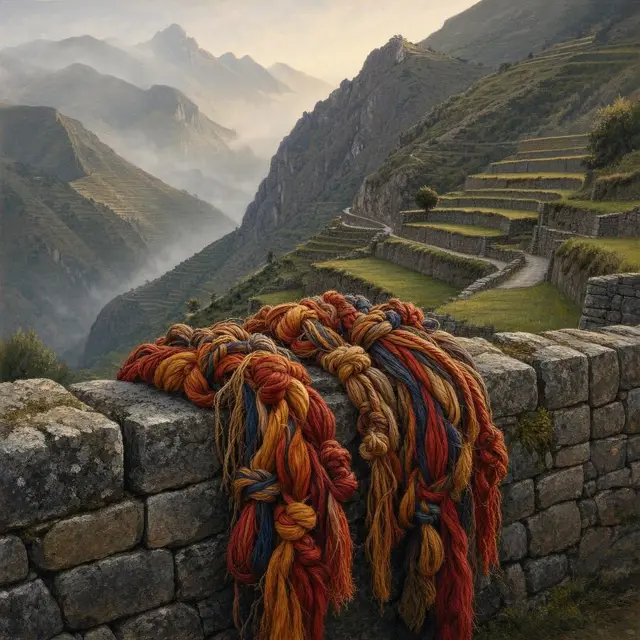
A huge road network called the Qhapaq Ñan tied the empire together and reached every corner of it. Along the roads stood rest shelters, each called a tambo, along with storehouses. They were spaced about one day's travel apart, so an army on the move could always eat and rest.
News moved on foot. Messengers called chasquis ran across the empire to deliver messages, chewing coca leaves for extra energy.
Inca builders were just as skilled. Their finest walls used stone blocks that fit so tightly that a knife could not slip between them, with no mortar holding them together. Builders lowered one rock onto another again and again, carving away the spots where dust got pressed. The tight fit has kept these walls standing through earthquakes for centuries. The best-known example is Machu Picchu, which Pachacuti is thought to have built.
Potatoes, Labor and Mountain Lungs
The Inca Empire ran largely without money and without markets. Instead, people paid their taxes in work, a labor duty called mit'a. In return, the rulers gave access to land, food in hard times, farm projects such as terraces, and big feasts for their subjects.
Farming was the main job. The potato was the staple food, with over 200 species and 5,000 varieties. People in the high Andes made chuño, potatoes dried in the freezing night air so they could be stored for a long time. At Moray, circular terraces worked like a farming lab, where crops from across the empire were grown.
The people themselves were built for the heights. Compared to other humans, Andeans had almost one-third larger lung capacity, about 2 liters more blood and double the hemoglobin. The Spanish who arrived in 1532 may have been taller, but the Incas coped with the thin mountain air far better.