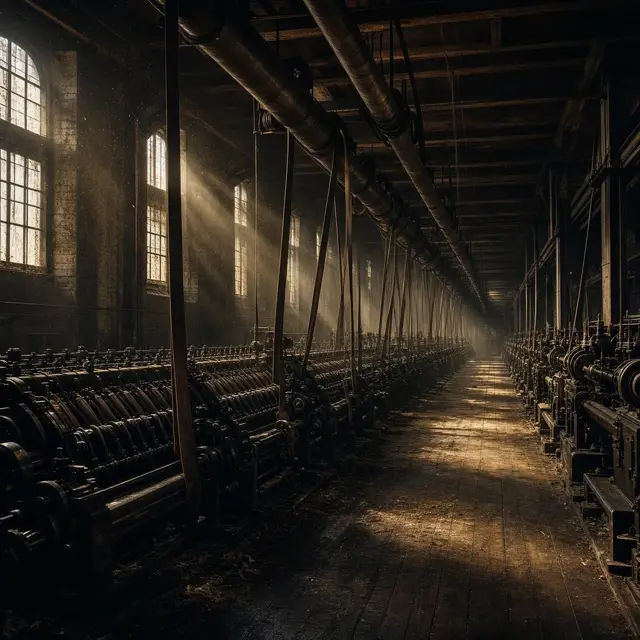
The Most Important Thing That Ever Happened
That is not an exaggeration for effect. Economic historians agree that the onset of the Industrial Revolution is the most important event in human history, comparable only to the adoption of agriculture in terms of material advancement.
It began in Great Britain around 1760 and had spread to continental Europe and the United States by about 1840.
What changed was how things were made: a shift from hand production to machines, new chemical manufacturing and iron production processes, growing use of water power and then steam power, the development of machine tools, and the rise of the mechanised factory system.
The consequence was not just more goods. Output rose enormously, and with it came an unprecedented rise in population and population growth. Average income and population both began to show sustained growth of a kind that had simply never existed before, and for most people in the Western world the standard of living improved, though some historians argue it did not meaningfully improve until the 20th century.
It Started With Cloth
For something so vast, the Industrial Revolution began in a narrow place: textiles.
The textile industry was the first to use modern production methods, and it became the dominant industry by every measure that mattered, employment, value of output, and capital invested. Rapid adoption of mechanised spinning happened in Britain in the 1780s, and mechanised textile production spread from Britain to continental Europe and the United States in the early 19th century.
Steam power and iron production only hit high growth rates after 1800, following textiles rather than leading them.
Britain was well placed to go first. By the mid-18th century it was the leading commercial nation, with GDP per capita considerably above the world average, and many of the technological and architectural innovations of the period were British. Before all this, most manufacturing in the world happened in China and India. Afterwards, most of it happened in North America and Western Europe.
A Word Coined Before Anyone Knew What It Meant
The phrase arrived remarkably early. The earliest recorded use of "Industrial Revolution" was in 1799, by the French envoy Louis-Guillaume Otto, announcing that France had entered the race to industrialise.
It became more common by the 1830s, and Friedrich Engels wrote in 1844 of "an industrial revolution, a revolution which... changed the whole of civil society". His book was not translated into English until the late 19th century, which is why the expression did not enter everyday language until then. Credit for popularising it usually goes to Arnold Toynbee and his 1881 lectures.
Not everyone accepts the framing. Historians such as John Clapham and Nicholas Crafts have argued the economic and social changes happened gradually and that calling it a revolution is a misnomer.
Others push the causes further back, arguing that early industrial activity across parts of Europe, the Islamic world, Mughal India and China created the conditions that made it possible in the first place.
The Air and the Aftermath
Growth did not run smoothly. A recession set in from the late 1830s, as the early innovations such as mechanised spinning and weaving slowed once their markets matured, even as locomotives, steamships and hot blast iron smelting spread. The electrical telegraph, widely introduced in the 1840s, was not enough on its own to restore high growth.
Rapid growth only returned after 1870, driven by the Second Industrial Revolution: steel-making processes, mass production, assembly lines, electrical grids and advanced machinery in steam-powered factories.
There was a price paid in the air people breathed. The emergence of great factories, and the enormous growth in coal consumption that came with them, produced an unprecedented level of air pollution in industrial centres. After 1900 a large volume of industrial chemical discharges was added to a growing load of untreated human waste.
That is where modern environmental regulation comes from. The first large-scale modern environmental laws were a British response to exactly this problem.