A Lucky Find on Rabbit Creek
On August 16, 1896, an American prospector named George Carmack was travelling with two Tagish men, Skookum Jim and Tagish Charlie, in Canada's remote Yukon. On a tip from another prospector, they looked for gold in a small stream then called Rabbit Creek. It held gold in huge amounts. The stream soon got a new name: Bonanza Creek.
Nobody is quite sure whether Carmack or Skookum Jim spotted the gold first. The group agreed to name Carmack as the official discoverer, because they feared the authorities would not accept an Indigenous man's claim. Carmack then staked a claim, marking out four strips of ground along the creek, two for himself and one each for Jim and Charlie.
By the end of August, the whole of Bonanza Creek had been claimed. A nearby stream, later named Eldorado Creek, proved even richer. When word reached Circle City, a busy mining town in Alaska, it soon became a ghost town. But winter froze the rivers, and the outside world only heard the full story in mid-1897.
The Stampede and the Ton of Goods
The rush began on July 14, 1897, when ships carrying Klondike gold reached San Francisco, and then Seattle three days later. The press reported over a million dollars in gold on board. The news landed during hard financial times in the United States, and about 100,000 people set out for the Klondike. Only around 30,000 to 40,000 actually got there.
Most had never mined before. Many were clerks and salesmen, and so many workers quit at once that it became famous. In Seattle, the mayor, twelve policemen and a large share of the streetcar drivers all left. Sellers stuck the word "Klondike" on all kinds of equipment, and newspapers called the craze "Klondicitis".
Then came the rule that shaped everything. To stop people from starving, Canadian authorities required every traveller to bring a year's supply of food, weighing about 520 kilograms. With tools and camping gear added, a typical stampeder hauled close to a ton. Even poor horses at the port of Dyea sold for up to $700.
Climbing the Chilkoot Pass
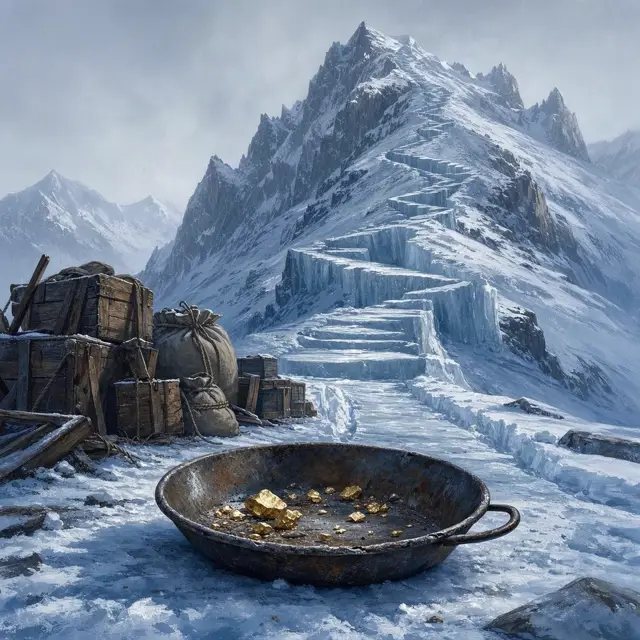
Most travellers sailed north to the Alaskan ports of Dyea and Skagway, then crossed the mountains on foot. About 22,000 people took the Chilkoot Trail. Just before the final climb was a flat ledge called the Scales, where goods were weighed before people entered Canada. The last slope was about 300 metres high and too steep for animals. Climbing it could take a whole day.
Nobody could carry a ton at once, so people split their gear into small loads and carried it up in relays. Packers, many of them local Tlingit people, carried goods for up to $1 a pound. Business owners cut 1,500 steps into the ice, called the "Golden Steps", and charged a daily fee to use them. By December 1897, Archie Burns had built a tramway where a horse turned a wheel that pulled freight up by rope.
The top of the pass was not the end. At Lakes Lindeman and Bennett, people built their own boats, and 7,124 of them set off in May 1898 for the last 800 kilometres down the Yukon River.
Dawson City, Where Gold Was Cash
At the end of the trail stood Dawson City, built where the Klondike and Yukon rivers meet. It grew from 500 people in 1896 to about 17,000 by the summer of 1898. Land prices shot up. A prime plot on Front Street could sell for $20,000, and a small log cabin rented for $100 a month.
Remote Dawson was always short of supplies. In the winter of 1897, salt became worth its weight in gold, and nails cost $28 a pound. When the first fresh food arrived in spring, eggs sold for $3 each. People were so hungry for news that some read the labels on food cans until they knew them by heart. One man bought a Seattle newspaper and charged a dollar a head to have it read aloud.
The rich spent wildly. Most payments were made in gold dust, and saloon floors held so much spilled gold that sweeping them made a profit. Jimmy McMahon once spent $28,000 in a single evening. A flashy gambler called Swiftwater Bill allegedly bought every egg in Dawson when the woman he loved dined with another man, then fed the eggs to dogs.
The Bust, Then the Books
The boom faded fast. In 1898 newspapers lost interest, and the Spanish-American War pushed the Klondike out of the headlines. "Ah, go to the Klondike!" became a popular phrase of disgust. Then in 1899 much more gold turned up at Nome in Alaska. About 2,500 people left Dawson for Nome in August and September alone, and the Klondike rush was over.
For most people, it never paid. Only a few hundred of the 100,000 who set out became rich, and only a handful stayed rich. Each traveller spent around $1,000 getting there, and together they spent more than the gold fields produced between 1897 and 1901.
The rush lived on in stories. Jack London went looking for gold but made his money mostly by working for prospectors. He later used the Klondike in his fiction, including The Call of the Wild, a 1903 novel about a sled dog. Photos of the Chilkoot climb inspired Charlie Chaplin's silent film The Gold Rush. Even slang stuck: newcomers were cheechakos, and old hands were sourdoughs.