A Library Inside a Temple to the Muses
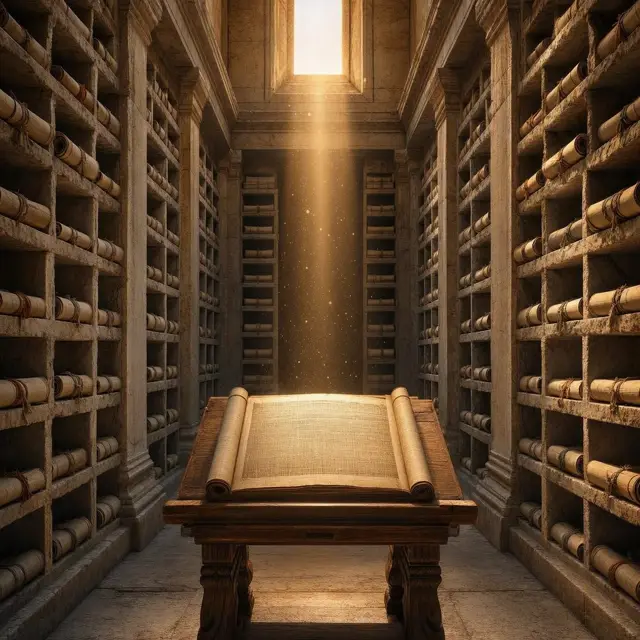
The Library of Alexandria in Egypt was one of the largest and most significant libraries of the ancient world — but it was not a standalone building. It was part of a larger research institution called the Mouseion, dedicated to the Muses, the nine goddesses of the arts. That word is where "museum" comes from.
The idea of a universal library at Alexandria may have been proposed by Demetrius of Phalerum, an exiled Athenian statesman living in the city, to Ptolemy I Soter. Ptolemy I may have drawn up plans, but the library itself was probably not built until the reign of his son, Ptolemy II Philadelphus.
It filled fast, because the Ptolemaic kings pursued aggressive and well-funded policies for acquiring texts. How many papyrus scrolls it held at any moment is unknown, and the estimates are wildly wide: somewhere between 40,000 and 700,000 at its height.
The Man Who Measured the Earth Worked Here
Alexandria came to be regarded as the capital of knowledge and learning, and the staff list explains why. During the third and second centuries BC the Library employed:
- Eratosthenes of Cyrene, who calculated the circumference of the Earth to within a few hundred kilometres
- Hero of Alexandria, who invented the first recorded steam engine
- Callimachus, who wrote the Pinakes, sometimes considered the world's first library catalogue
- Zenodotus of Ephesus, who worked to standardise the works of Homer
- Aristophanes of Byzantium, who invented Greek diacritics and first divided poetic texts into lines
Read that list again. Someone worked out the size of the planet, someone else built a working steam engine, and a third person invented the idea of cataloguing a collection — all in the same institution, more than two thousand years ago. Apollonius of Rhodes wrote the epic *Argonautica* there, and Aristarchus of Samothrace produced the definitive texts of Homer.
It Was Not One Fire
The popular story is a single catastrophe. The reality is a long, grinding decline across several centuries — and it began with politics, not flames.
The decline started with the purging of intellectuals from Alexandria in 145 BC, during the reign of Ptolemy VIII Physcon. The head librarian, Aristarchus of Samothrace, resigned and exiled himself to Cyprus. Other scholars — Dionysius Thrax, Apollodorus of Athens — fled to other cities and continued teaching there. The Library lost its people before it lost its books.
The famous fire did happen, and it was an accident. Julius Caesar accidentally burned the Library, or part of its collection, during his civil war in 48 BC. But it is unclear how much was actually destroyed, and it seems to have either survived or been rebuilt shortly after. The geographer Strabo records visiting the Mouseion around 20 BC, and the enormous scholarly output of Didymus Chalcenterus in that period suggests he still had access to at least some of its resources.
Death by Budget Cut
What finally killed the Library was the least dramatic force imaginable: money.
The Library dwindled through the Roman period from a simple lack of funding and support. Its membership appears to have ceased by the 260s AD — not burned, not banned, just unfunded until there was nobody left in it.
Whatever physically remained was probably destroyed between 270 and 275 AD, when Alexandria saw a Palmyrene invasion and an imperial counterattack. The daughter library established in the Serapeum during the reign of Ptolemy III Euergetes — a temple to the Greco-Egyptian god Serapis — may have outlived the main Library. It was mainly a gathering place for Neoplatonist philosophers following Iamblichus, and it was vandalised and demolished in 391 AD under a decree issued by bishop Theophilus of Alexandria. The greatest library of the ancient world ended not in one blaze but in a slow sequence of exiles, budget cuts and invasions.