A Skyscraper Before Skyscrapers
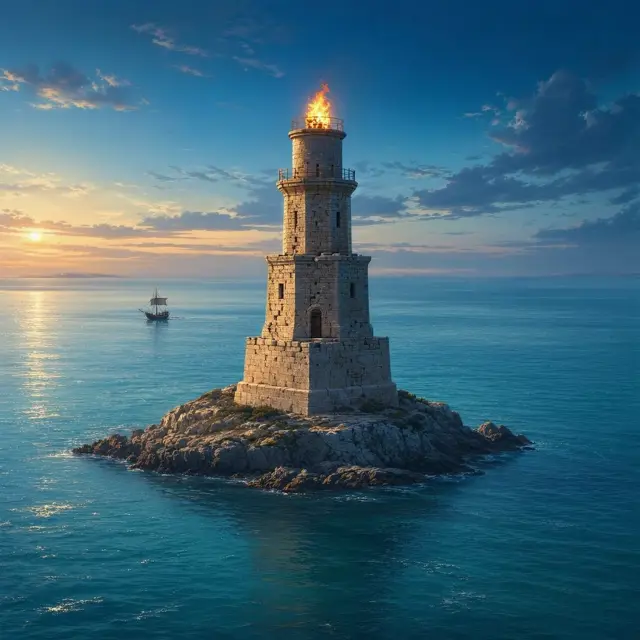
More than 2,000 years ago, a tower of at least 100 metres rose over the harbour of Alexandria. For many centuries, it was one of the tallest human-made structures in the world. It was also one of the Seven Wonders of the Ancient World, and only two others lasted longer: the Mausoleum at Halicarnassus and the Great Pyramid of Giza.
It stood on Pharos, a small island off the Egyptian coast. In 332 BC, Alexander the Great founded Alexandria facing that island. The two were later joined by the Heptastadion, a mole more than 1,200 metres long.
Over time, silt piled up and widened the mole until it vanished under the modern city. The old island survives only as the Ras el-Tin promontory. The exact spot where the lighthouse stood has been worn away by the sea.
Twelve Years and 800 Talents of Silver
Sailing into Alexandria was risky. The coast was flat and hard to spot, with shallow shoals and hidden reefs. Legend even says the people of Pharos were wreckers, which is why a guiding light was needed.
Ptolemy I ordered the lighthouse soon after he declared himself king in 305 BC. It was finished under his son, Ptolemy II. The work took twelve years and cost 800 talents of silver. Scientists have traced its sandstone and limestone blocks to the Wadi Hammamat quarries, in the desert east of Alexandria.
The architect may have been Sostratus of Cnidus, though this is disputed. The writer Lucian told a fun story about him. Sostratus supposedly carved his own name into the stone, then covered it with plaster bearing the name of Ptolemy. When the plaster eventually fell off, Sostratus's name would shine through.
What the Travellers Saw
Most of what we know comes from Arab writers, and their accounts agree closely. They give heights of 103 to 118 metres on a square base 30 metres wide. The tower had three tapering tiers: a square bottom, an octagonal middle, and a round top. At its peak, a mirror reflected sunlight by day, and a fire burned by night.
The geographer Al-Idrisi visited in 1154 and saw lead poured between the stone blocks at the base. The fullest description comes from the traveller el-Balawi, who came in 1166. He measured the inside and described a ramp wide enough for two horsemen to pass at once, with dozens of rooms on its upper floors.
Ibn Battuta passed by twice. In 1326 he could still enter. By 1349 it had fallen into such ruin that he could not even climb up to the doorway.
Shaken Down, Then Found Underwater
Earthquakes did what time alone could not. Quakes in 796 and 951 cracked the tower. The one in 956 brought down its top 20 metres. The worst came in 1303, from near Crete, hundreds of kilometres away. In 1480, Sultan Qaitbay built a fort on the site using the fallen stones.
For centuries, the rest sat on the sea floor. In 1968, a UNESCO expedition of marine archaeologists led by Honor Frost confirmed the ruins were there. In 1994, a French team led by Jean-Yves Empereur explored the Eastern Harbour and found granite blocks weighing 49 to 60 tonnes, 30 sphinxes and 5 obelisks.
By the end of 1995, the team had catalogued over 3,300 pieces. Thirty-six of them are now on display in Alexandria's museums. Divers can still visit the ruins today, and in 2025 some entrance and foundation stones were raised to help build a digital reconstruction.
A Name That Lit Up Languages
The lighthouse vanished, but its name kept shining. In modern Greek, the word pharos simply means 'lighthouse'. It spread into many other languages too: phare in French, faro in Italian and Spanish, farol in Portuguese, and far in Romanian and Bulgarian.
It did not stop there. In French, Spanish, Russian and several other languages, a word from the same root means a car's headlight. So every time a driver in Paris or Madrid flicks on their lights, they are echoing a tower from ancient Egypt.
The building's shape lived on as well. A tomb in Abusir, about 48 kilometres from Alexandria, is thought to be a small copy, with the same square, eight-sided and round tiers. The lighthouse still appears on the flag and seal of the Alexandria Governorate. Even a crater on Proteus, a moon of Neptune, is named Pharos after the island.