The People Who Never Vanished
You may have heard that the Maya mysteriously disappeared. They did not. Today, more than 6 million Maya people live in nearly the same area as their ancestors, speaking more than 28 Mayan languages.
Their homeland covered what is now southeastern Mexico, all of Guatemala and Belize, and parts of Honduras and El Salvador. The first Maya villages appeared before 2000 BC, and the first cities rose around 750 BC.
Farmers grew maize, beans, squash and chili peppers. The Maya built great cities such as Tikal and Calakmul, linked by busy trade routes. Even after the Spanish conquest in the 1500s, many villages kept their languages, crafts and way of life.
Counting With Zero
Here is something that surprises many people: the Maya used a symbol for zero. This may be one of the earliest known uses of an explicit zero anywhere in the world. The oldest clear example appears on monuments from 357 AD.
Their number system was simple and clever. A dot meant one and a bar meant five. Instead of counting in tens like we do, they counted in twenties, a system called vigesimal.
The position of a symbol changed its value. The bottom level counted ones, the next counted twenties, and the one above that counted 400s. With this, the Maya could write huge numbers and even add them up by combining dots and bars.
A Calendar Still in Use
The Maya took calendars further than any other people in the region. They tracked the Moon, the Sun, eclipses and the planets with great accuracy. Their solar year was even more accurate than the Julian calendar used in Europe at the time.
They ran several cycles side by side. One lasted 260 days, another 365 days, and together they formed a 52-year cycle. A separate Long Count kept track of very long stretches of time from a fixed starting day in 3114 BC.
The most remarkable part is that the 260-day calendar never died. It is still used today in Maya communities in the highlands of Guatemala and Chiapas, more than a thousand years after the great cities fell quiet.
Writing That Took Centuries to Crack
Maya writing is the most advanced writing system known from the Americas before Columbus. It mixes signs for whole words with signs for sounds, so it could closely follow the spoken language. Scholars call these signs glyphs.
More than 10,000 texts have been found, carved on stone monuments, painted on pottery, and written in folding books made from tree-bark paper. Only trained scribes from noble families could write, and some even signed their work.
After the Spanish conquest, the knowledge of how to read the script was lost. Scholars began to crack it in the late 1800s, and big breakthroughs came from the 1950s onward. By the end of the 20th century, most Maya texts could finally be read again.
Ballcourts, Chocolate and a Great Collapse
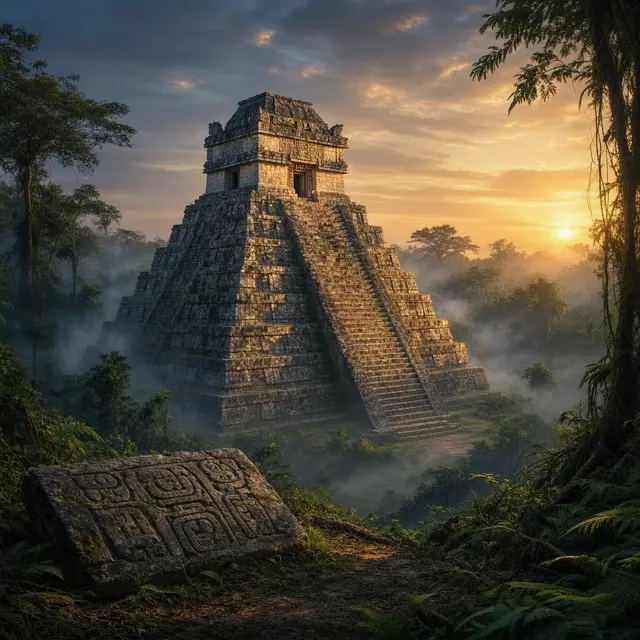
Maya cities were full of pyramids, palaces and ballcourts, long stone playing areas shaped like a capital I. The Great Ballcourt at Chichen Itza is the largest in the region, 83 metres long with walls over 8 metres high.
The Maya also loved chocolate. Nobles drank chocolate drinks, and cacao beans were so valuable they were used as money. They were worth so much that people even made fake ones.
Then, in the 9th century, many southern cities were abandoned within 50 to 100 years. No single cause is agreed on, but war, too many people for the land, and drought all likely played a part. The last dated Long Count inscription was carved in 909.