A Test Run With Oysters on the Menu
Before the famous train ran, there was a trial. In 1882, Georges Nagelmackers, the son of a Belgian banker, invited guests on a 2,000 km railway trip aboard his "lightning luxury train". It left Paris on 10 October 1882, just after 18:30, and reached Vienna the next day at 23:20.
The train had baggage cars, four sleeping coaches and one restaurant coach. The first dinner on board was a feast: oysters, soup with Italian pasta, turbot with green sauce, chicken, fillet of beef, lettuce, chocolate pudding and a buffet of desserts.
Nagelmackers had founded the company known as CIWL. It went on to run luxury trains, travel agencies and hotels across Europe, Asia and North Africa. But its most famous creation remains the Orient Express, which began regular service the following year.
Paris to Constantinople, With Boats
The first Express d'Orient left Paris for Vienna on 5 June 1883. A few months later the route was extended, but reaching Constantinople was not simple. At Giurgiu in Romania, passengers took a ferry across the Danube to Bulgaria. There they caught another train to Varna and finished the journey by boat.
In 1885 a new route appeared, mixing rail with a stretch by carriage to Plovdiv. Only on 1 June 1889 did the first direct train leave Paris for Constantinople. The service was officially renamed the Orient Express in 1891.
The eastern terminus was Sirkeci station, next to the Golden Horn in Istanbul. From piers beside it, ferries carried travellers across the Bosphorus to the station on the Asian side. So the line ran from one edge of Europe to a short boat ride from Asia.
The Golden Age of Sleeping Cars
In 1919 a new route opened through the Simplon Tunnel, Milan, Venice and Trieste. It was called the Simplon Orient Express, and it soon became the most important rail link between Paris and Istanbul.
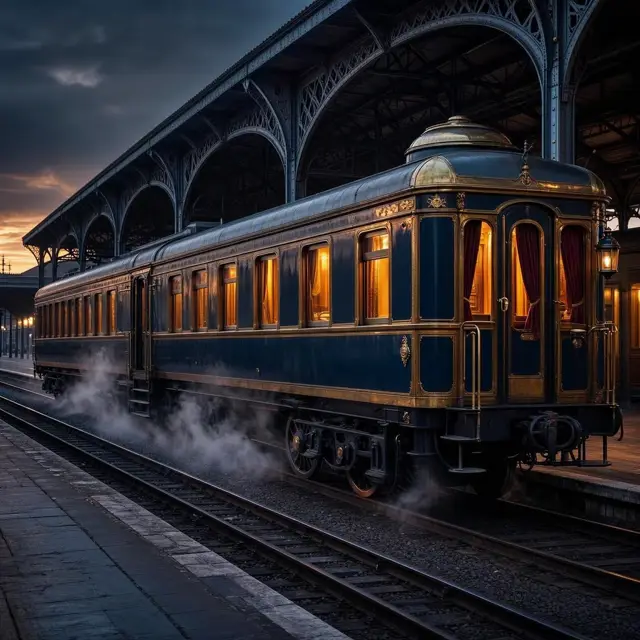
The 1930s were the peak. Three parallel services ran at once: the Orient Express, the Simplon Orient Express and the Arlberg Orient Express. This is when the train earned its name for comfort. It carried sleeping cars with staff on board at all times, and restaurant cars famous for their food. Royalty, nobles, diplomats and business people all rode it.
The network reached even further. Each service included sleeping cars that ran from Calais to Paris, stretching the trip from one end of continental Europe to the other. Although the original train was just a normal timetabled service, its name became a byword for intrigue and luxury rail travel.
The Long, Slow Goodbye
The decline came in steps. By 1962 only one main service was left, and it was replaced by a slower Direct Orient Express. In 1971 the CIWL company stopped running its own carriages and leased its rolling stock to national railways instead. The last direct Paris to Istanbul service ran on 19 May 1977.
Even then, the name lived on. A train called the Orient Express kept running, but the route kept shrinking: to Bucharest, then Budapest in 1991, then Vienna in 2001. When a new high-speed line opened in 2007, the train was cut back to start in Strasbourg instead of Paris.
The end came in December 2009, when the last train bearing the name, now spelled Orient-Express with a hyphen, left Vienna. It was called a "victim of high-speed trains and cut-rate airlines."
Back on the Rails in Vintage Carriages
The legend refused to stay parked. In 1976 a Swiss travel company rented and later bought old CIWL carriages and ran them as the Nostalgic Istanbul Orient Express. For the train's 100th birthday in 1983, it ran all the way from Paris to Istanbul.
In 1982, businessman James Sherwood launched the Venice Simplon-Orient-Express. It uses restored carriages from the 1920s and 1930s, runs from March to December, and tickets start at US$3,262 per person. Funny detail: despite its name, it runs through the Brenner Pass, not the Simplon Tunnel.
Another revival is on the way. In 2017 Accor bought a 50% stake in the Orient Express brand. In 2018 it began restoring 17 old CIWL carriages from the 1920s and 1930s, with trips between Paris and Istanbul planned to begin in late 2026.