From Frontier Principality to Empire
For more than six centuries, a single dynasty ruled one of history's great empires, and it started very small. Around 1299, a Turkoman tribal leader named Osman I founded a beylik, a small principality, in northwestern Anatolia on the Byzantine frontier.
Osman himself is a figure of obscure origin. His early followers were Turkish tribal groups and Byzantine defectors, not all of them Muslim. He expanded by taking Byzantine towns along the Sakarya River, helped by a Byzantine defeat at the Battle of Bapheus in 1302.
His successors kept going. They conquered much of Anatolia and pushed into the Balkans by the mid-14th century, turning a petty kingdom into a transcontinental empire. At its height it spanned much of Southeastern Europe, West Asia and North Africa.
1453: The City That Changed Hands
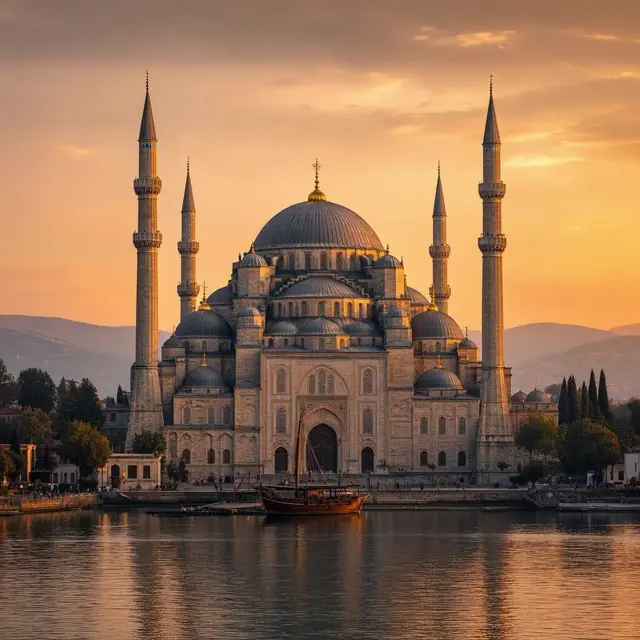
The defining moment came in 1453, when Sultan Mehmed II conquered Constantinople and brought the Byzantine Empire to an end. The city became the Ottoman capital.
Further conquests by Selim I led the sultans to adopt the title of caliph. With Constantinople as its seat and control over a large part of the Mediterranean Basin, the empire sat at the centre of relations between the Middle East and Europe for six centuries.
It governed an enormously diverse population in a distinctive way. The empire granted varying levels of self-rule to its many religious communities, known as millets, allowing them to manage their own affairs. Ruling many peoples at once was not a side issue for the Ottomans. It was the core of how the state worked.
The Age of Suleiman the Magnificent
The empire became a true global power under Suleiman the Magnificent, who reigned from 1520 to 1566. His campaigns reshaped the map of Central Europe.
Suleiman captured Belgrade in 1521. After his historic victory at the Battle of Mohacs in 1526, he established Ottoman rule over much of present-day Hungary and other Central European territories.
His reach extended across the sea as well, sometimes in surprising partnerships. The conquests of Nice in 1543 and Corsica in 1553 were joint ventures between the French king Francis I and Suleiman, commanded by the Ottoman admirals Hayreddin Barbarossa and Dragut. The empire also controlled parts of southeastern Central Europe from the early 16th to the early 18th centuries.
What the Name Really Means
The word Ottoman is an English version of the name Osman, the empire's founder. Osman is itself the Turkish form of the Arabic name Uthman. In Ottoman Turkish, the state called itself *Devlet-i Aliye-yi Osmaniye*, the Sublime Ottoman State.
The labels inside the empire were layered. *Osmanli* first meant Osman's tribal followers, then the empire's military and administrative elite. *Turk* referred to the Anatolian peasant and tribal population and could be a disparaging term for educated city dwellers. Many educated urban Turkish speakers called themselves *Rumi*, meaning "Roman", after the lands of the former Byzantine Empire.
Western Europeans, meanwhile, used Ottoman Empire, Turkish Empire and simply Turkey interchangeably. That ended between 1920 and 1923, when the new government based in Ankara chose Turkey as the sole official name.
Reform, Decline and the Final Chapter
Historians today place the start of the decline after the defeat at the Second Siege of Vienna in 1683, though the empire kept a flexible, strong economy and military well into the 18th century. By the late 18th century it had fallen behind the rest of Europe technologically, and defeats by Austria and Russia cost it territory.
The 19th century brought serious reform. Under Mahmud II and the Tanzimat reforms, the state became more organised and a new Ottoman identity took hold. In 1876 it attempted a constitutional monarchy, before reverting to absolute rule under Abdul Hamid II. Reformers known as the Young Turks restored the constitution in the 1908 revolution.
The end came with World War I, which the empire joined on the side of the Central Powers. Afterward, the victorious Allies occupied and partitioned it. The Turkish War of Independence, led by Mustafa Kemal Ataturk, followed, and the Ottoman sultanate was abolished in 1922.