The 36-cent ticket
In 1928, an American named Richard Halliburton swam the Panama Canal. Like every vessel, he had to pay a toll. His bill was 36 cents, the lowest toll ever paid. At the other end of the scale, the cruise ship Norwegian Pearl paid 375,600 US dollars in 2010. In August 2026, a gas company paid a record 5.3 million dollars at an auction just to skip the line.
Why pay so much? The canal is an 82-kilometre shortcut across the narrowest point of the isthmus of Panama. It connects the Caribbean Sea with the Pacific Ocean. Without it, ships must take the long, risky trip around the southern tip of South America.
Here is a fun twist. Because of the shape of the land, a ship going from the Atlantic to the Pacific actually travels from northwest to southeast. The Pacific end is east of the Atlantic end.
The French dream that ran out of money
The first serious try was French. It was led by Ferdinand de Lesseps, the man who had already built the Suez Canal. In 1879 he called a big meeting in Paris to back his plan. Of the 136 delegates, only 42 were engineers. He wanted a canal at sea level, just like Suez.
Work began on 1 January 1881. Panama turned out to be far harder than the desert. In the rainy season the Chagres River became a raging torrent, rising up to 10 metres. Landslides kept filling the main cut through the mountains. Worst of all were yellow fever and malaria. Nobody yet knew that mosquitoes spread them, so health measures failed.
By 1889 the company was bankrupt. An estimated 22,000 workers had died from disease and accidents, and 800,000 investors lost their savings. Even Gustave Eiffel was among those prosecuted in the scandal that followed.
Winning the war on mosquitoes
The United States took over the project on 4 May 1904. It inherited a tired workforce and piles of old French machines in poor shape. The first American chief engineer quit within about a year.
The turning point came from a doctor, Colonel William C. Gorgas. Scientists had recently shown that yellow fever and malaria were spread by mosquitoes. Gorgas went after them hard. His teams built city water systems, fumigated buildings, sprayed oil on breeding spots, fitted window screens and drained still water. One commission member called his ideas barmy. Gorgas kept going anyway.
After two years of this work, the mosquito diseases were nearly gone. Chief engineer John Frank Stevens also rebuilt housing, cafeterias and the railway for the thousands of new workers. American workers even got a medal for every two years of service, and 7,189 of them were handed out.
A lake lifted into the hills
The big decision was how to build it. An expert panel wanted a sea-level canal. Stevens had seen the Chagres River in full flood, and he called that plan "an entirely untenable proposition." He won the argument.
His idea was clever. Dam the river to make a huge lake 26 metres above sea level. Then use locks to lift ships up to the lake and lower them down on the other side. Gravity would do the work, letting water flow from the lake into the locks. Gatun Lake became the largest human-made lake in the world at the time.
Ships leave the lake through the Culebra Cut, a 12.5-kilometre trench through the continental divide. Over a hundred steam shovels helped dig it. On 10 October 1913, a telegraph signal from the White House set off a blast that flooded the cut. The canal opened on 15 August 1914, two years ahead of schedule.
Ships built to fit the box
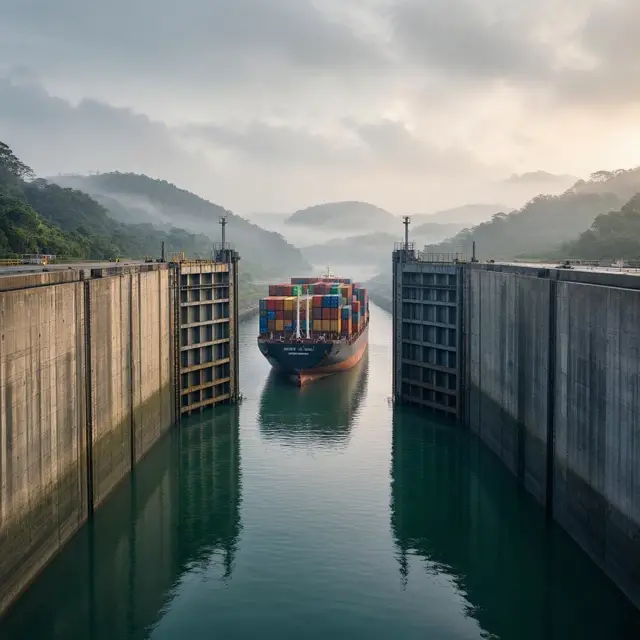
The canal is so important that many ships are built to the biggest size it allows. These are called Panamax ships. The original locks are 33.5 metres wide and 320 metres long. Their steel gates are about 2 metres thick and 20 metres high. When the aircraft carrier USS Saratoga first squeezed through in 1928, its overhanging deck knocked over every concrete lamp post along the canal.
By 2011, about 37 percent of the world's container ships had grown too big to fit. So Panama voted to expand the canal, with about 80 percent approval. New locks opened on 26 June 2016. They are 427 metres long and 55 metres wide, and fit ships carrying around 12,000 containers.
Water is the canal's weak spot. Each ship passing uses about 200 million litres of fresh water. The new locks have basins that reuse 60 percent of it. Under treaties signed in 1977, full control passed to Panama at noon on 31 December 1999.