A $5 Letter and an Impossible Promise
In 1856, it took months for news of the presidential election result to reach the West. Then three businessmen made a bold promise: mail from St. Joseph, Missouri, to Sacramento, California, in just 10 days. Many people said it was impossible. Their trick was simple. Swap the slow stagecoach for relays of fast riders on fresh horses.
William Russell, Alexander Majors and William Bradford Waddell already ran a huge freight business, with 6,000 men and 75,000 oxen at its peak. They put the Pony Express together in just two months in the winter of 1860, gathering 80 riders, 184 stations and 400 horses.
It was not cheap. The first price was $5 for half an ounce, 250 times the normal postage of 2 cents. That is about $180 in 2025 money, or two and a half days of a semi-skilled worker's pay. The price later fell to $1, but even that was seen as expensive. Partly because of the cost, only 250 known examples of Pony Express mail survive today.
How the Relay Worked
The route ran about 1,900 miles (3,100 km). It roughly followed the Oregon and California trails, then crossed Utah and Nevada, went over the Sierra Nevada and came down to Sacramento. From there, the mail usually went by steamer down the river to San Francisco. Along the way stood about 190 stations.
There were two kinds of stops. At a swing station, the rider swapped his tired horse for a fresh one and kept going. At a home station, riders got a bed and a meal between runs. A rider changed horses 8 to 10 times on a run of 80 to 100 miles, and the service ran day and night in all weather.
The horses moved at a fast canter of 10 to 15 miles per hour and sometimes hit a full gallop of 25 miles per hour (40 km/h). They averaged about 14.2 hands high and 900 pounds, small enough that the name "pony" fit, even if not strictly correct every time. The riders were small too. None could weigh more than 125 pounds (57 kg).
The Clever Leather Pouch
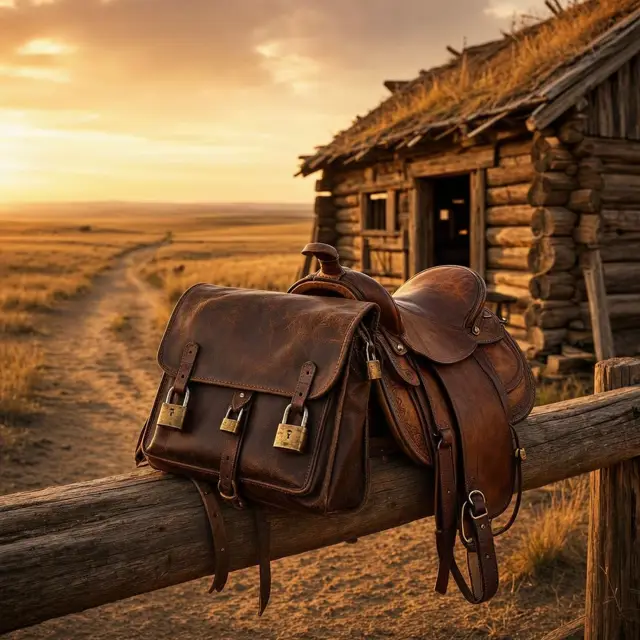
The real star was the mochila, a leather cover thrown over the saddle. Its name comes from the Spanish for pouch or backpack. Holes were cut so the saddle horn and the back of the saddle poked through, and the rider's own weight held it in place. At each station, the rider took only the mochila with him to the fresh horse.
Each corner had a cantina, a box-shaped hard leather pocket that was padlocked shut for safety. Normal mail bags were never used, because hooking them on and off at every stop would add up to long delays. The mochila could hold 20 pounds (9 kg) of mail.
The saddles were special too. Israel Landis, who had opened a small saddle shop in St. Joseph in 1844, made lightweight saddles using less leather, metal and wood than usual. Weight was cut everywhere else as well, until the horse carried little beyond the rider, the mail and a few basics. Every pound saved meant a faster horse.
Race Trains and Record Rides
The very first run nearly started late. The messenger bringing mail from the East missed a train connection in Detroit and reached Hannibal, Missouri, two hours behind. So the railroad cleared the track and sent a special one-car train that crossed Missouri, 206 miles, in a record 4 hours and 51 minutes. After speeches and a cannon shot, the first rider left St. Joseph at about 7:15 pm on April 3, 1860.
The mail reached Sacramento on April 14, keeping the 10-day promise. Later that year came the most famous run. Riders carried news of Abraham Lincoln's election from Fort Kearny, Nebraska, to Fort Churchill, Nevada, over snowy trails. California's newspapers got the news just 7 days and 17 hours after East Coast papers.
Some riders did amazing things. Jack Keetley once rode 340 miles (550 km) in 31 hours without stopping to rest or eat, and was lifted from the saddle sound asleep at the end. William Cody, later known as Buffalo Bill, is said to have ridden 322 miles in 21 hours and 40 minutes using 21 horses, though his stories may have been exaggerated.
Beaten by a Wire
The Pony Express lasted only about 18 months. On October 24, 1861, the first transcontinental telegraph was completed. Two days later, on October 26, the Pony Express announced it was closing. A faster way to send messages had arrived, and riders could not compete with it.
Money was a problem too. Despite a heavy subsidy, the service took in $90,000 and lost $200,000. The founders had hoped to win a big government mail contract, but it went to a rival stagecoach line instead. In all, the riders delivered about 35,000 letters between St. Joseph and Sacramento.
Its fame only grew after it ended. In 1869, the US Post Office issued its first stamp showing a real historic event, and it chose the Pony Express. Until then, stamps showed only the faces of figures like George Washington and Benjamin Franklin. The route became a National Historic Trail in 1992, passing through eight states, and in 2015 Google marked its 155th anniversary with a playable doodle game.