Warriors on Horseback
The word samurai is thought to come from saburau, meaning one who serves. That is exactly what they were: professional warriors who served a lord.
They rose to power because Japan's old army did not work well. Until the late 8th century, Japan relied on a national army in which each soldier was a conscript, an ordinary man called up for a short period of service. These soldiers were poorly trained and struggled against enemies who fought on horseback. Battles were usually decided by skilled mounted archers from wealthy families, who could afford horses and years of private training. By 792, the imperial court had ended the conscript army.
In the countryside, landowning warrior families took over the job of keeping order. Two big clans became especially powerful, the Minamoto and the Taira, and they turned into bitter rivals at the imperial court.
Their showdown, the Genpei War of 1180 to 1185, ended with the Minamoto victorious and the Taira clan effectively destroyed.
Swords, Guns and the Warring States
From 1467, Japan fell into more than a century of civil wars known as the Sengoku period, with regional lords, each called a daimyo, fighting one another for control.
It was a time when the old rules broke down. Servants sometimes overthrew their own lords, and people born outside the warrior class could fight their way up. Toyotomi Hideyoshi rose from a peasant background to become a samurai, a powerful lord, and finally the Imperial Regent.
Then, in 1543, Portuguese explorers taught the Japanese how to make the matchlock musket. At first, these guns were prestige items carried only by samurai. But some lords noticed that a musket took just a week or two of training to master, compared with years for a sword or a bow, so they handed them to large numbers of peasant foot soldiers. By the end of the period, there were hundreds of thousands of guns in Japan.
On the battlefield, long heavy swords fell out of use. They were replaced by the shorter, lighter katana.
Warriors Without a War
After winning the Battle of Sekigahara, Tokugawa Ieyasu took control of the country and became shogun in 1603. After 1615 came around 250 years of peace, and that changed the samurai completely.
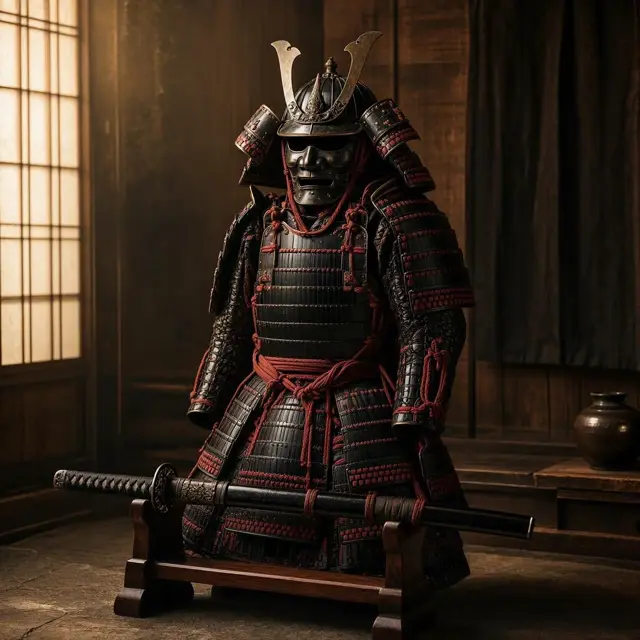
With no wars to fight, samurai slowly lost their military role. Most moved from the countryside into castle towns, and being a samurai became a fixed status passed down through families. Many worked as officials, police, teachers and administrators. From 1629, samurai on official duty had to wear two swords, but by the end of the era those swords were more a badge of rank than a weapon for daily use.
They were also highly educated. Samurai had strong reading and writing skills, and some kept a personal library of texts on strategy and warfare. One such library held 20,000 volumes. By the end of the Tokugawa period, nearly all women of the samurai class could read, too.
A samurai who lost his master became a ronin, a warrior who served nobody.
The End of the Samurai
Pressure from outside brought the old order down. When the American Commodore Matthew Perry arrived with his expedition in 1853, he exposed how weak Japan's coastal defences were.
In 1867, the last Tokugawa shogun handed power back to the emperor, and the new Meiji government took over. Many of its leaders were former samurai themselves. But step by step, the special position of the samurai was taken apart. The old domains were abolished in 1871. Conscription came back in 1873, so fighting was no longer a family privilege. Their state payments ended, and so did the right to wear swords.
Some former samurai adapted well, putting their education to work in business, the army and politics. Others lost their income and status, and some rebelled. The biggest of these uprisings, the Satsuma Rebellion of 1877, was the last major armed revolt by former samurai. It failed.
The class lived on in name only. It remained legally recognised until 1947.