The Warrior State
Sparta was a powerful city-state in ancient Greece, in a region called Laconia in the south. From the 7th century BC, it became the strongest land military power in the Greek world, and stayed that way until its defeat at the Battle of Leuctra in 371 BC.
Spartan society was built around war. A full citizen, called a Spartiate, was legally banned from ordinary money-making work, so he could focus entirely on military training.
That way of life depended on others doing the work. Most people living under Spartan rule had the status of helot: local people who were enslaved, owned by the state and made to farm the land.
Sparta was also unusual in having two kings at the same time, from two royal families, with equal power. Over time, most real power passed to a group of officials, each called an ephor, and to a council of elders over the age of 60. The kings still led the army in war.
Raised to Fight
Training began early. At the age of seven, Spartan boys entered the agoge, a tough education system designed to build discipline, physical toughness and loyalty to the state.
Boys lived together in shared quarters and were fed just enough to keep them lean, and to teach them what it felt like not to have enough. They were trained to survive hard times, even if that meant stealing. Alongside weapons training, they learned reading, writing, music and dancing.
They were also expected to answer questions briefly and wittily, and faced punishment if they did not. That habit gave us the word laconic, meaning using very few words.
At 20, a Spartan joined a dining group of about fifteen men, where soldiers learned to rely on one another. Men could marry at 20 but could not live with their families until 30, and they stayed in the reserve army until 60.
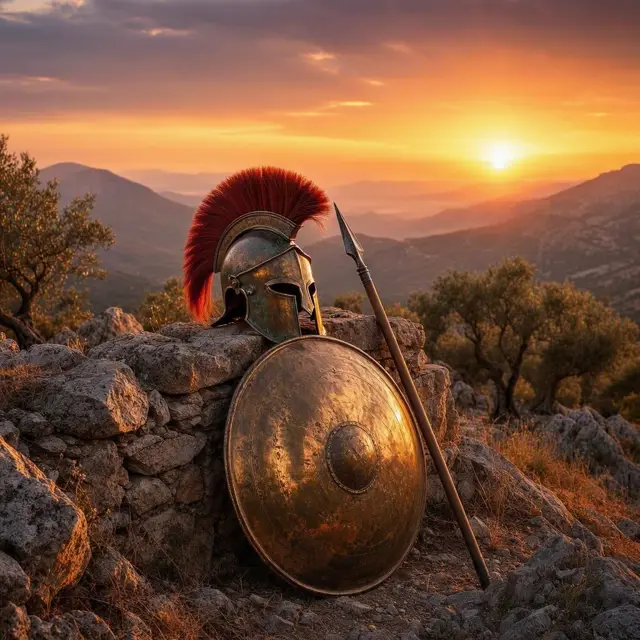
In battle, the shield mattered most, because it also protected the man standing beside you. Losing it was a far greater disgrace than losing a helmet.
The Stand at Thermopylae
Sparta's most famous moment came in 480 BC, when the huge Persian army of King Xerxes invaded Greece. At the narrow pass of Thermopylae, the Spartan king Leonidas led a small force, including about 300 full Spartan citizens alongside soldiers from other Greek cities, in a legendary last stand.
Leonidas died in the battle. But a year later, in 479 BC, Sparta gathered its full strength and led the Greek alliance to a decisive victory at Plataea, ending Persia's hopes of expanding into Europe.
Spartan soldiers fought in a phalanx, a tight formation of men standing close together behind their shields, and their bronze armour and discipline made them feared.
Not every famous Spartan story is true. Spartan women were said to hand men their shields with the words: with this, or upon this, meaning come back victorious or come back dead. Historians see this as almost certainly propaganda. In reality, Spartans buried their dead near the battlefield instead of carrying them home.
The Freest Women in Greece
Spartan women had a status and freedom unknown elsewhere in the ancient Greek world. Girls were fed the same food as their brothers, exercised outdoors and even competed in sports.
They received a formal education in music, dance, singing and poetry. No other Greek city-state gave women any formal education, and Spartan women were known for being able to read and count, and for speaking their minds in public.
They also married later, usually in their late teens or early 20s rather than at 12 or 13, and they controlled property. In later times, women owned at least 35 percent of all the land in Sparta.
Some Spartan women made history. Gorgo, the wife of Leonidas, is said to have worked out how to reveal a secret warning hidden under the wax of a wooden tablet, showing that Persia was about to invade. In 396 BC, Cynisca, the sister of a Spartan king, became the first woman to win an Olympic chariot race.
Sparta's name lives on: today, the word Spartan means simple and without comfort.