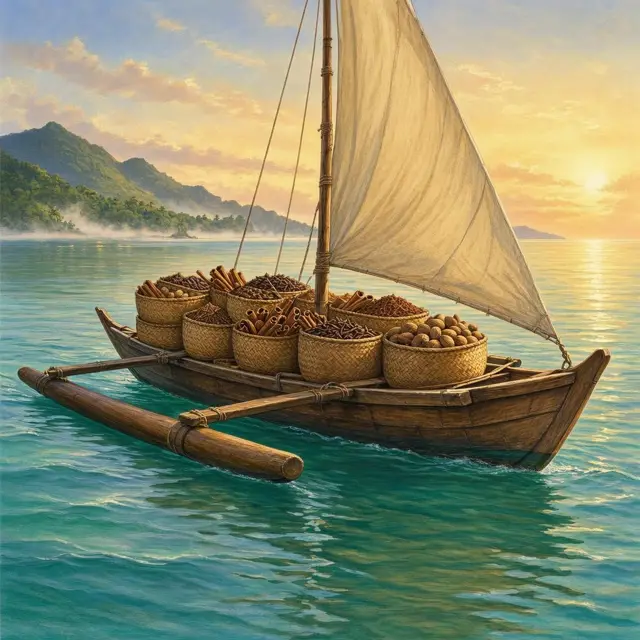
The Sailors Who Got There First
Long before European ships arrived, the spice trade was already ancient. People around the Indian Ocean and Island Southeast Asia were trading spices, seashells and gemstones as early as the 10th millennium BC. In the 3rd millennium BC, the ancient Egyptians traded with a place they called the Land of Punt, near the Red Sea coast.
The first true sea trade network in the Indian Ocean belonged to the Austronesian peoples. By around 1500 BC, sailors from what is now Indonesia had built routes to South India and Sri Lanka, and later to China.
They sailed in catamarans and outrigger boats, carrying cinnamon and cassia all the way to East Africa with help from the westerly winds. Cloves and nutmeg from the Maluku Islands travelled along with them. Their network eventually stretched so far that Austronesian people settled Madagascar by the first half of the first millennium AD.
Riding the Seasonal Winds
In the first millennium BC, Arabs, Phoenicians and Indians traded spices, gold, pearls and ebony by land and sea. One route ran up the Red Sea to the port of Berenice in Egypt, then overland to the Nile, then by boat to Alexandria. Spices, silk and fine cloth also travelled along the overland Incense Route.
This trade made South Arabia so rich that the ancient Greeks called it Eudaemon Arabia, "the elated Arabia". Further north, the Nabateans controlled the road from Petra to Gaza.
Then came a clever shortcut. In the late second century BC, Greeks from Egypt learned from Indian sailors how to use the monsoon to sail straight from Aden to India's west coast. Tamil texts record Greeks buying large sacks of black pepper in India, and many recipes in the 1st-century Roman cookbook Apicius use it.
Secret Islands and Rich Republics
By the 7th and 8th centuries, Arab traders, mostly descended from sailors from Yemen and Oman, ruled the sea routes of the Indian Ocean. They reached as far as the secret "spice islands" in today's Indonesia. Arab sailing guides from the 14th and 15th centuries finally spelled it out: east of Timor lie the Banda Islands, home of nutmeg and mace, and the islands of cloves are called Maluku.
Sailors would set out from Basra, stop at many ports, and come home to sell their spices in Baghdad. Goods from the islands passed through ports like Kozhikode in India and reached Jeddah and the Persian Gulf.
From there, overland routes led to the Mediterranean. Between the 8th and 15th centuries, Venice, Genoa and other Italian sea republics held a monopoly on Europe's trade with the Middle East. Spices were among the most expensive products of the Middle Ages, used in medicine as well as cooking, making these cities extremely wealthy.
The Race Around Africa
Venice and Genoa acted as middlemen for nearly everything coming from the East. Other European powers wanted to break that hold, so they began building up their fleets. Portugal decided to sail around Africa.
In 1488, Bartolomeu Dias rounded the Cape of Good Hope. Nine years later, Vasco da Gama set out with four ships, crossed the Indian Ocean and reached Calicut in South India in 1498. In early 1512, a Portuguese expedition reached the Banda Islands, then the world's source of nutmeg. They were the first Europeans ever to arrive there.
Spain joined the race too. Christopher Columbus was sent west to find a route to the spices of Asia, but he landed on the Caribbean island of Hispaniola instead. Later, Ferdinand Magellan's fleet crossed the strait at the tip of South America on 21 October 1520 and reached the Philippines in 1521. In 1522, Juan Sebastian Elcano brought the last remaining ship, the Victoria, home to Spain.
Boats, Bananas and Curry Houses
The spice trade moved far more than spices. Austronesian sailors brought sewn-plank boats, catamarans and outriggers to India, the Middle East, East Africa and China. Their influence still lives in language. The words for "ship" in Tamil, Telugu and Kannada all come from an old Austronesian word for "sailboat", a cousin of the Hawaiian halau and the Maori wharau.
They also spread useful cultigens: bananas, coconuts, yams, wetland rice, ginger, sugarcane and sandalwood all reached southern India, Sri Lanka and eastern Africa this way.
Food flowed in every direction. Indian merchants brought spice mixes and black pepper to today's Malaysia and Indonesia, while coconut milk dishes and rice cakes took root in India and Sri Lanka. Europeans brought baking to India, and Indian food adapted to European tastes was on offer in England by 1811. From 1571 to 1815, the Manila Galleon linked the Philippines to Mexico, creating the first trans-Pacific trade route.