Too Many Weavers, Not Enough Thread
In the 1700s, the cloth trade of northern England had a problem. John Kay improved the loom with an invention called the flying shuttle. It let one weaver double his output. Suddenly weavers needed far more yarn than spinners could make.
Spinning was slow hand work, often done at home. Before it came carding, and it took three carders to prepare the fibre for one spinner. Up to three spinners were then needed to keep one weaver busy. Whole families did the work, from the youngest to the oldest, and the weaver went to market once a week to sell the cloth.
Cotton yarn production simply could not keep up with demand. James Hargreaves, born around 1720 in Oswaldtwistle, near the town of Blackburn in Lancashire, spent time thinking about how to speed things up. Around 1764-1765 he came up with his answer: the spinning jenny, a machine that would help start the Industrial Revolution.
Eight Spindles, One Pair of Hands
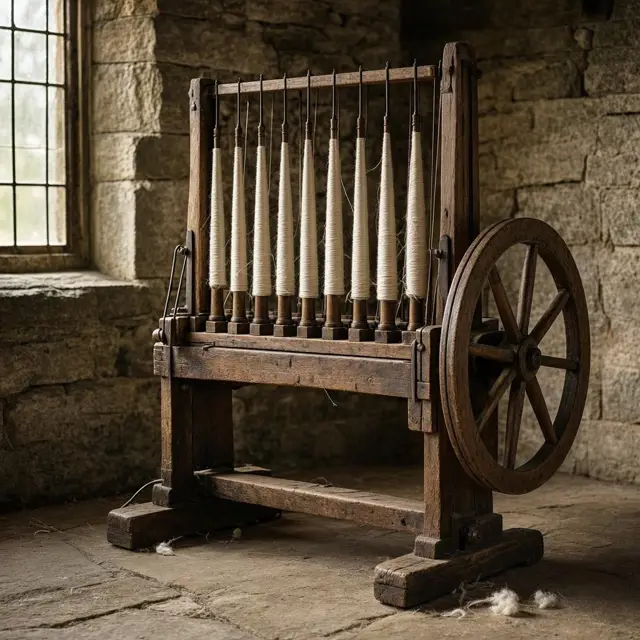
Hargreaves built a frame with eight wooden spindles at one end. A set of eight rovings was fixed to a beam on the frame. The rovings passed between two wooden bars that could be clasped together.
The spinner used the left hand to draw the bars along the top of the frame, stretching the thread. With the right hand, they quickly turned a wheel that made all the spindles spin at once, twisting the thread. When the bars were pushed back, the thread wound onto the spindles. A pressing wire called a faller guided it into the right place.
The result was simple and powerful. One worker could now run eight or more spools at once, and as the technology improved, that number grew to 120. The jenny's yarn was coarse and not very strong. But it was cheap and plentiful, which is exactly what the busy new looms were hungry for.
A Secret Machine and a Lost Lawsuit
Hargreaves kept the machine secret for a while and built a number of them for his own growing business. The price of yarn fell, which angered the large community of spinners in Blackburn, and his machines were smashed. In 1768 he left for Nottingham, a centre for knitted silks, cottons and wool.
There he built jennies in secret for a Mr Shipley, helped by a joiner named Thomas James. The two men set up a textile business on Mill Street. On 12 July 1770, Hargreaves finally took out a patent on his invention, number 962, for a machine for spinning, drawing and twisting cotton.
By then, many spinners in Lancashire were already using copies. Hargreaves told them he was taking legal action. The manufacturers met and offered him £3,000. He first demanded £7,000, then held out for £4,000. But the case fell apart when it came out that he had sold several machines himself in the past.
From Cottage Work to the Factory
The jenny worked because it held more than one ball of yarn. It made more yarn in less time and cut the overall cost. It also depended on the flying shuttle. Without faster looms hungry for yarn, it would not have been such a success.
It had limits too. The rovings still had to be prepared on a wheel, and carding was still done by hand. Even so, the jenny stayed in common use in the cotton and fustian trade until about 1810. It was then replaced by a newer machine, the spinning mule. The jenny was also adapted for another step of the process, becoming the basis of a machine called the Slubbing Billy.
Its bigger legacy was the way it changed work itself. The spinning jenny helped start the factory system of cotton manufacturing.
So Who Was Jenny?
The most popular story says that one of Hargreaves' daughters, or his wife, named Jenny knocked over a spinning wheel. The wheel kept working normally, with its spindle now pointing straight up. Hargreaves realised that spindles did not have to lie flat, as they always had. He could stand a whole row of them upright.
It is a charming tale, but the records do not back it up. Hargreaves had several daughters, and none of them was named Jenny. Neither was his wife. A more likely explanation is that "jenny" was simply short for "engine".
There are rival stories as well. Thomas Highs of Leigh claimed to be the real inventor, and the same knocked-over wheel tale is told with his wife's name instead. Another story says a man named Thomas Earnshaw built a similar spinning device, then destroyed it. He feared he might be taking bread out of the mouths of the poor.