Built and Rebuilt Over 1,500 Years
Stonehenge is not one monument but several, laid on top of each other. Construction ran through distinct phases spanning at least 1,500 years, and there is evidence of activity around the site stretching back as far as 6,500 years.
The name is old too. The Oxford English Dictionary points to a 10th century glossary where henge-cliff means precipice. Writers in the 11th century recorded stanenges near Salisbury, understood as stones supported in the air. The second half may come from the Old English for hinge, since the horizontal stones hinge on the uprights, or from a word meaning to hang.
That word went on to name a whole class of monument. Archaeologists use henge for an earthwork with a circular bank and a ditch on the inside. It was a place of burial from the beginning, and cremated remains have been found from its earliest period through to its peak.
Stones From Far Away
Two kinds of stone make up the circle. The sarsen stones are the giants, blocks of hardened sandstone from the chalk downs of southern England. A 2020 study matched 50 of the 52 sarsens to West Woods, about 25 kilometres north.
The smaller bluestone blocks travelled much farther. They came from the Preseli hills of southwestern Wales, roughly 230 kilometres away, and excavations at Waun Mawn suggest they may first have stood in a stone circle there before being taken down and moved. In 2024, research published in Nature traced the Altar Stone to northeast Scotland, some 700 kilometres off.
Why carry rock that far is a fair question. Researchers from the Royal College of Art found the bluestones have unusual acoustic properties and ring loudly when struck. A Welsh village near their source used local bluestones as church bells until the 18th century.
Stone Cut Like Timber
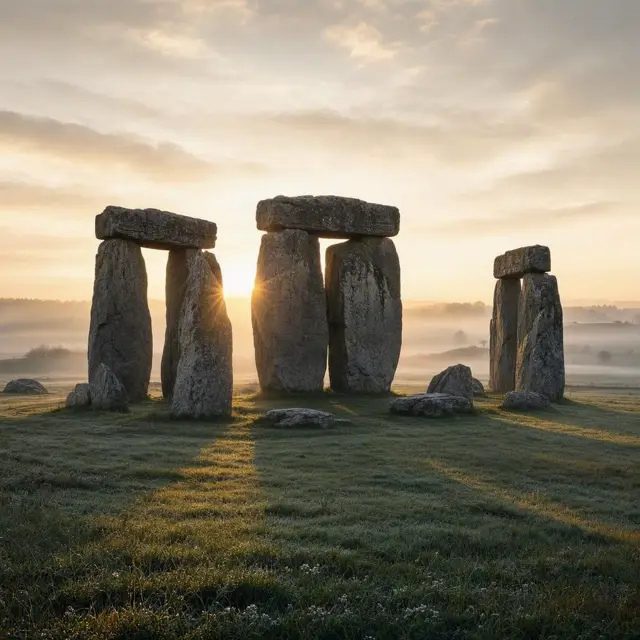
Around 2600 to 2400 BC, 30 enormous sarsens were dressed and raised into a circle about 30 metres across, each standing roughly 4 metres high and weighing around 26 tonnes. A ring of 30 horizontal lintel stones sat on top of them.
The joinery gives the builders away. The lintels were fixed to the uprights with mortise and tenon joints, and to each other with tongue and groove joints. Both are woodworking methods, used here on 26 tonne blocks of stone.
The visual thinking is just as careful. The uprights widen slightly toward the top so they look the same width from the ground, and the lintels curve to keep the ring looking round. Inside the circle stood five trilithon structures in a horseshoe, each a pair of uprights carrying a single lintel, with stones weighing up to 50 tonnes. The tallest rose almost 7.5 metres.
Why It Was Built, and Who Owns It
The culture that raised Stonehenge left no written records, so purpose is argued rather than known. What is clear is the alignment: the great trilithon, the horseshoe, the heel stone and the avenue all line up with sunset at the winter solstice and sunrise at the summer solstice.
Animal bones offer a clue about when people came. Teeth found at nearby Durrington Walls suggest as many as 4,000 people gathered for midwinter and midsummer, and isotope analysis shows some animals were brought from as far as the Scottish Highlands.
No supernatural help was needed to build it. In 1995, a team of more than 100 workers pushed and pulled a 40 tonne slab on a sledge across the 29 kilometres from the Marlborough Downs.
In 1915 the monument was sold at auction as Lot 15. Cecil Chubb bought it for 6,600 pounds on a whim, thinking a local man should own it, and gave it to the nation three years later.