A Well That Hit an Army
On 29 March 1974, farmers Yang Zhifa, his five brothers, and their neighbour Wang Puzhi were digging a well about 1.5 km east of a large earthen mound outside Xi'an, in Shaanxi. They hit fired clay.
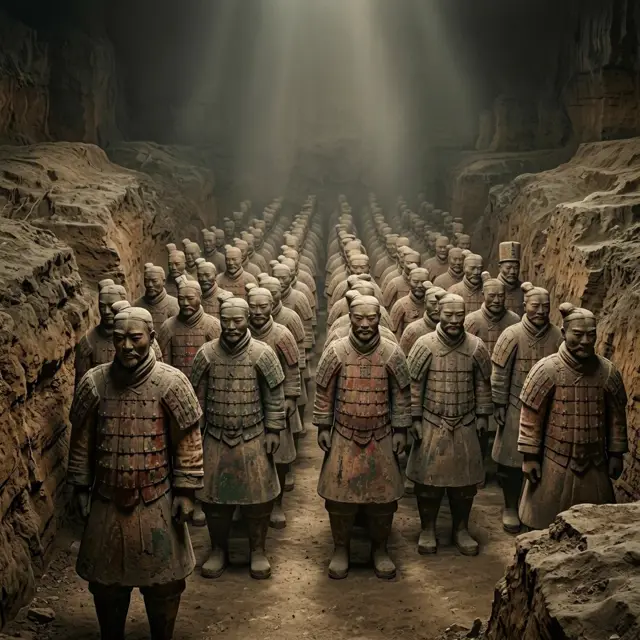
What they had found was the outer edge of the Terracotta Army, a collection of terracotta sculptures depicting the armies of Qin Shi Huang, the first emperor of China. The figures date from roughly the late 200s BCE and were buried with the emperor in 210–209 BCE.
They were not decoration. This is funerary art with a job: the army was placed there to protect the emperor in his afterlife. Whoever ordered it was not being symbolic about the threat. He wanted a real army, in the correct formations, with real weapons, facing the right direction — an entire military establishment committed to the ground on the assumption that death is a place where you might still need one.
Eight Thousand Soldiers and Seven Hundred Thousand Workers
The scale is difficult to hold in your head. Estimates from 2007 put the three pits at more than 8,000 soldiers, 130 chariots with 520 horses, and 150 cavalry horses — the majority of which remain in situ, still in the ground where they were placed.
Pit 1 alone measures 230 metres long and 62 metres wide and holds the main army of over 3,000 figures. Later digging turned up non-military figures too: officials, acrobats, strongmen and musicians. The emperor was not only taking soldiers with him.
The labour behind it matches the ambition. Construction began in 246 BCE, when Qin Shi Huang succeeded his father as King of Qin at the age of 13. The historian Sima Qian recorded that the project eventually involved 700,000 conscripted workers. A teenager ordered his own tomb, and a substantial fraction of a country spent decades building it.
Mass Production With Ten Faces
The warriors are famous for a claim that turns out to be more interesting than the myth. They were not individually sculpted from scratch — they were built on an assembly line. Heads, arms, legs and torsos were made separately and then assembled, which is how you produce thousands of figures at all.
But the workshops refused to let them look identical. Scholars have identified 10 base facial forms, each then further developed and detailed so that the finished warriors read as distinct people rather than copies. Modular production, individual finishing.
The figures also vary in height according to rank, with the generals the tallest. This is a small, telling detail: the sculptors were not merely making an army, they were encoding its hierarchy into the clay, so that anyone looking at the ranks could tell at a glance who outranked whom — even in a chamber intended for no living viewer at all.
The Colour That Vanishes in Four Minutes
The grey-brown warriors in every photograph are not what the emperor commissioned. They were originally painted in vivid pigments including cinnabar for red, malachite for green, and azurite for blue. Buried, that paint survived for over two thousand years.
Excavation is what destroys it. The lacquer layer beneath the paint can begin to curl within fifteen seconds of exposure to Xi'an's dry air, and can flake away in as little as four minutes. Archaeologists are, quite literally, racing a clock measured in seconds.
The weapons fared better. Over 40,000 bronze items have been recovered — swords, daggers, spears, lances, battle-axes, scimitars, shields, crossbows and crossbow triggers. Early research suggested they had been deliberately coated with a 10–15 micrometre layer of chromium dioxide to prevent corrosion, an astonishing claim of ancient chemistry. Research in 2019 deflated it: the chromium was contamination from nearby lacquer, not a preservation treatment.
The Tomb Nobody Has Opened
Here is the part that unsettles people. The army guards a central burial chamber that remains unopened — a hermetically sealed space of roughly 100 by 75 metres.
Sima Qian described what lies inside: a model of the empire in which 100 flowing rivers were simulated using mercury, with the heavens depicted above. For a long time this read as the usual ancient exaggeration.
Then soil testing found high levels of mercury in the tomb mound. The account is no longer easy to dismiss. That evidence cuts both ways — it makes the chamber more tantalising and more dangerous, and it is one reason excavation has not proceeded, alongside the certainty that opening it would destroy whatever colour and organic material survives inside. The site was inscribed as a UNESCO World Heritage Site in 1987. The emperor's own tomb, meanwhile, is still doing exactly what he intended: staying shut.