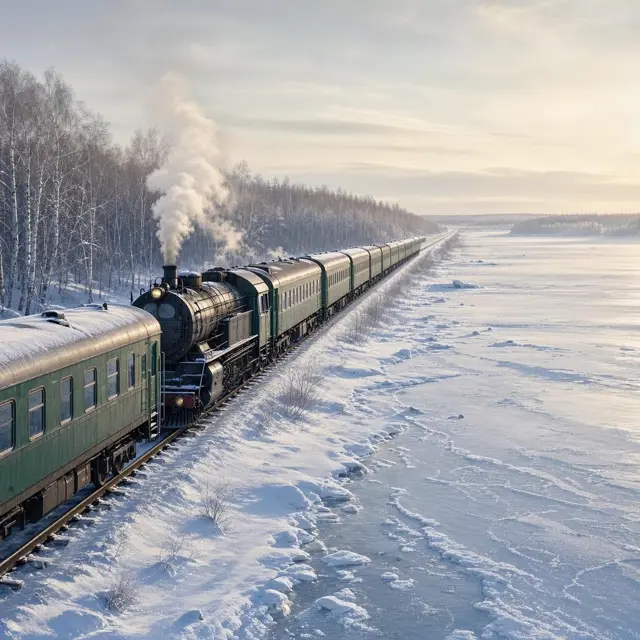
Eight Time Zones on One Line
The Trans-Siberian Railway is the longest railway line in the world. It runs from Moscow in the west to Vladivostok in the east, a track length of 9,289 kilometres. Along the way it spans a record eight time zones, and the full journey takes eight days.
Even so, it was only the third-longest single continuous train service in the world. The Moscow to Pyongyang service ran 10,267 kilometres, and the former Kyiv to Vladivostok service ran 11,085 kilometres. Both of them followed the Trans-Siberian for much of the way.
The main route leaves Moscow from Yaroslavsky station. It passes big cities such as Omsk, Novosibirsk, Krasnoyarsk, Irkutsk and Khabarovsk on its way across southern Siberia. Its highest point is the Yablonovy pass in the Yablonoi Mountains, at 1,070 metres above sea level. There, the line slips through a tunnel to avoid the heights.
Why Siberia Needed Rails
In the late 19th century, getting around Siberia was hard. Roads for wheeled carts were rare. For about five months a year, rivers were the main way to travel. In winter, horse-drawn sledges carried people and cargo over winter roads, and many of those roads were simply frozen rivers.
The rivers had another problem. Big ones like the Yenisei and the Lena were mostly navigable only from north to south, so moving goods from west to east was difficult. A canal joining the Ob and the Yenisei did not help much.
The design work took 10 years. To save money and avoid fights with landowners, planners decided to lay the line outside existing cities. That choice hurt one city badly. Tomsk, the largest settlement at the time, had swampy riverbanks, so the railway crossed the Ob 70 kilometres to the south, at a town later renamed Novosibirsk. Tomsk only got a dead-end branch line.
The Icebreaker That Came as a Kit
Work officially began in 1891. On 19 May that year, Tsarevich Nicholas, who later became Tsar Nicholas II, opened construction in Vladivostok. The line was split into seven sections, and most of them were built at the same time by 62,000 workers.
Lake Baikal was a giant obstacle. It is more than 640 kilometres long and more than 1,600 metres deep. Until a railway was built around it, the track simply stopped on both shores. An icebreaking train ferry called the SS Baikal made the four-hour crossing. It could carry 24 railway coaches and one locomotive on its middle deck.
The Baikal was a knock-down vessel. It was first bolted together in Newcastle upon Tyne in England, and every part was given a number. Then it was taken apart into many hundreds of pieces and shipped to Listvyanka, where a shipyard was built just to put it back together. A smaller ferry, the Angara, still survives as a museum in Irkutsk.
Wheat, Settlers and Wobbly Tracks
The line filled up with local traffic right away, mostly wheat. From 1896 to 1913, Siberia sent out about 501,932 tonnes of grain and flour each year on average. The railway also brought millions of farming families from the west. Between 1906 and 1914 alone, about four million peasants arrived in Siberia.
Not everyone calls it a success. Historian Christian Wolmar argues it was built for narrow political reasons and to a poor standard. He describes light rails that broke easily, wooden ties made from green wood that rotted in the first year, and embankments often only 3 metres wide instead of the planned 4.9 metres.
The line kept getting better. Since 1916 it has directly connected Moscow with Vladivostok, and it had a double track along its whole length by 1939. The electrification of the line began in 1929 and was finished in 2002. It allowed trains to double their weight, up to 6,000 tonnes.
A Freight Shortcut Across Asia
The Trans-Siberian is also a major cargo route. A trainload of containers can travel from Beijing to Hamburg in as little as 15 days, using the Trans-Mongolian and Trans-Siberian lines. The railway can usually deliver containers in one third to one half of the time a sea voyage takes.
In 2009, the best times for cargo trains from Russia's Pacific ports to the western border were around 12 days. Those trains covered about 900 kilometres a day, with a top speed of 80 kilometres per hour. That same year, Russian Railways announced a plan called "Trans-Siberian in Seven Days" to cut the trip to a single week.
Other lines reach beyond Russia. The Trans-Mongolian line heads south through Ulaanbaatar to Beijing. The Moscow to Beijing express on the Trans-Manchurian route takes just over six days. There have even been proposals for new bridges or tunnels to link the network to Tokyo, through the islands of Sakhalin and Hokkaido.