Two Weeks Down to Two Minutes
Before 1858, news crossed the Atlantic only by ship. A bad winter storm could delay it by weeks. A message and its reply on the same day was simply impossible.
The man who set out to change that was Cyrus West Field, a businessman and financier. He knew nothing about undersea cables or the deep sea, so he asked experts. Ocean charts showed a workable route across the seabed. It looked so ideal for cable laying that it was named Telegraph Plateau.
Field moved fast. Before he had even formed a company, he ordered 2,500 nautical miles of cable. He crossed the Atlantic 56 times during the project. In 1856 the Atlantic Telegraph Company was born, with Field putting up a quarter of the money himself. A slogan coined later said it all: "Two weeks to two minutes".
A Cable Twisted the Wrong Way
The cable had a core of seven copper strands, wrapped in layers of gutta-percha, then tarred hemp, then steel wires. It was rushed. Two different firms made the outer layers, and late in the work someone noticed their wires were twisted in opposite directions. The halves could not be joined normally. A wooden bracket saved the day, but the mistake brought bad press.
No single ship could carry it all, so two warships shared the load: HMS Agamemnon and USS Niagara. The 1857 attempt failed when the cable snapped over water about 3,200 metres deep.
In 1858 they tried a new plan. The ships met in mid-Atlantic, joined their cables with a splice, and sailed in opposite directions. A brutal storm nearly ended the trip, and the cable broke three more times. On the next try, it finally reached both shores in early August 1858.
Two Minutes for a Single Letter
On 16 August 1858, the first official message crossed the ocean: a short note announcing that Europe and America were now linked. It was a triumph, but a painfully slow one.
Messages were sent in Morse code, and the signal was so weak that one letter or number took two minutes to get through. That is about 0.1 words per minute. A congratulatory message from Queen Victoria took 67 minutes to reach Newfoundland. The confirmation copy took 16 hours to come back.
Nobody cared about the speed at first. New York fired a salute of 100 guns the next morning and hung its streets with flags. A parade followed on 1 September, with a torchlight march and fireworks. The fireworks set the Town Hall on fire. The engineer Charles Bright was knighted, the first such honour for anyone in the telegraph business.
The Man Who Pushed Too Hard
Behind the scenes, two experts were feuding. William Thomson, a respected scientist, had invented the mirror galvanometer, a very sensitive device that could read faint signals by eye. Wildman Whitehouse, the chief electrician, was a medical doctor who had taught himself electrical engineering. He wanted to blast the cable with huge voltages so ordinary printing machines could read it.
Whitehouse drove up to 2,000 volts through the line, and the insulation began to fail. Worse, he could not read the Queen's message with his own gear. He quietly used Thomson's galvanometer, then typed the message into his printer so it looked like his method had worked.
About three weeks after it opened, the cable died. Whitehouse was blamed and dismissed. In later tests, a cable sample with a tiny pinprick hole "lit up like a lantern". Still, 732 messages got through, and one cancelled army order saved the British government £50,000.
A Giant Ship Goes Fishing
Field did not give up, but it took until 1864 to raise new money. The new cable was nearly twice as heavy as the old one. It was laid by the SS Great Eastern, a ship with an immense hull fitted with three iron tanks for 2,300 nautical miles of cable.
In 1865 the cable snapped more than halfway across, and the end sank. In July 1866 the Great Eastern tried again and reached Heart's Content, Newfoundland, in thick fog, and this time the line held.
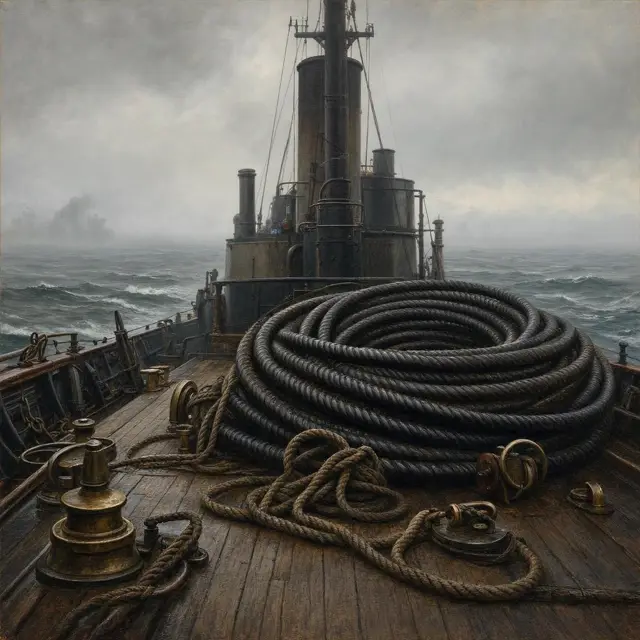
Next, the crews went back for the lost 1865 cable, lying about 4 kilometres down. Finding it was like looking for a needle in a haystack. They lowered a five-pronged grappling hook on a stout rope, caught the cable, and lost it again several times in rough seas. When they finally hauled it up and spliced it, there were two working lines. The new cable sent 8 words a minute, 80 times faster than in 1858.