The Helmets Were Invented in the 1800s
Start with the thing everybody knows, because it is wrong. There is no evidence that Vikings wore horned helmets. That costume detail first appeared in the 19th century.
It is a good marker for how much of the popular picture is invented. Popular ideas of the Vikings differ strongly from the complex, advanced society that archaeology and historical sources actually describe. A romantic image of Vikings as noble savages began forming in the 18th century and spread widely during the 19th-century Viking revival.
What we inherited is two competing myths, both shaped by the early 20th century: violent piratical heathens on one side, bold adventurers on the other. Current portrayals usually run on those clichés and are rarely accurate.
The plainer truth is less cinematic. Most Vikings were farmers, fishermen, craftsmen and traders.
How Far They Actually Went
The reach is the genuinely astonishing part, and it beats the fiction.
From the late 8th to the late 11th centuries, people from what is now Denmark, Norway and Sweden raided, traded and settled across Europe, and travelled as far as the Mediterranean, North Africa, the Middle East, Greenland and Vinland, in present-day Newfoundland. They were the first Europeans to reach North America, roughly five hundred years before Columbus, with a short-lived settlement at L'Anse aux Meadows around the year 1000.
They went east as well, along the Dnieper and Volga trade routes, where they were known as Varangians. One group of Rus Vikings went so far south that they served briefly as bodyguards to the Byzantine emperor, and then attacked Constantinople. They also sailed to the Caspian Sea and to Arabia.
The settlements stuck: the British Isles, the Faroes, Iceland, Greenland, Normandy and the Baltic coast.
The Countries They Accidentally Created
Raiding is temporary. What the Vikings left behind is structural, and some of it is still on the map.
The Normans, the Norse-Gaels, the Rus, the Faroese and the Icelanders all emerged from Norse colonies. The founding of Kievan Rus' made them ancestors of the later states of Belarus, Russia and Ukraine. They shaped the political and social development of England and of parts of France, and they left a permanent mark on the English language.
Place names give the game away across northern Europe. Ormskirk comes from Orms kirkja, the Church of the Worm. Tórshavn is Thor's Harbour. Odense means a place where Odin was worshipped. Kaupanger is Market Harbour.
The institutions travelled too. The Tynwald, the parliament of the Isle of Man, still carries Viking influence in its very existence.
A Society With Laws, Runes and Rank
The Vikings spoke Old Norse and wrote in runes, carving inscriptions that survive across Scandinavia and beyond. They had their own laws, art and architecture. For most of the Viking Age they followed the Old Norse religion, gradually becoming Christian between the 8th and 12th centuries.
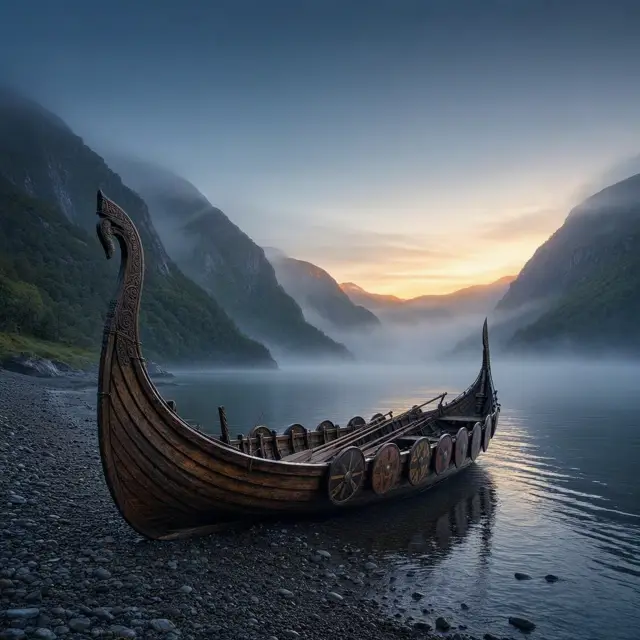
They were also expert sailors and navigators, and their longships are what made all the rest possible.
It was not an equal society. At the bottom were thralls, enslaved people who were despised and looked down upon, supplied either by birth or captured abroad on raids and brought back to Scandinavia by boat, where they were put to hard labour building fortifications, canals, roads and mounds. Their appearance was regulated too: thralls were usually the only men with short hair, while most Viking men wore their hair and beards shoulder-length.
Over the same period the Norse homelands consolidated from many small kingdoms into three: Denmark, Norway and Sweden.