Mostly Empty Space
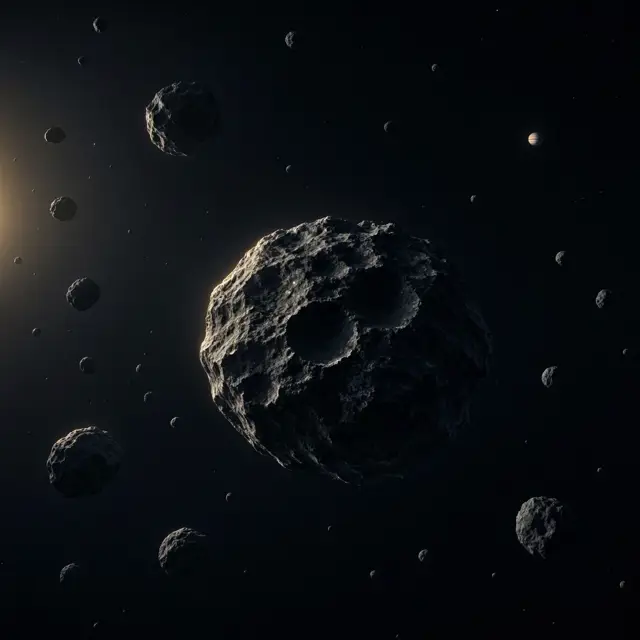
Forget the popular image of a crowded field of tumbling boulders. The real asteroid belt, between Mars and Jupiter, is mostly empty. On average, its asteroids are about 965,600 km apart. You would have to aim very carefully just to reach one.
There are still a lot of them. Somewhere between 700,000 and 1.7 million asteroids are at least 1 km wide. But all of them together add up to only about 3% of the Moon's mass. The biggest, Ceres, holds about 39% of the belt's mass on its own and is large enough to count as a dwarf planet.
When Pioneer 10 became the first spacecraft to cross the belt in 1972, people worried it might get hit. It came through fine, and so have many others since. The odds of a probe running into an asteroid are estimated at less than 1 in 1 billion.
The Hunt for a Missing Planet
The belt was found because astronomers were sure a planet was hiding there. In 1596, Johannes Kepler wrote, "Between Mars and Jupiter, I place a planet." He thought the gap between the two was just too big.
In 1766, a simple number pattern now called the Titius-Bode law seemed to predict where the planets sit, as long as one planet was missing between Mars and Jupiter. When Uranus was found in 1781 in an orbit that matched the pattern, some astronomers became convinced the missing planet was real.
On 1 January 1801, Giuseppe Piazzi spotted Ceres in exactly the predicted spot. Around the same time, a group of 24 astronomers nicknamed the Celestial police formed to search that region. One of them found Pallas about 15 months later. But these new objects stayed tiny points of light even in the best telescopes. In 1802, William Herschel named them asteroids, from a Greek word meaning star-like. When Neptune turned up far from where the pattern predicted, most astronomers decided it was just a coincidence.
The Planet That Never Was
So why is there no planet there? Blame Jupiter. In the early Solar System, small rocky building blocks were clumping together to make planets. In the belt, Jupiter's huge gravity kept stirring them up.
The key is orbital resonance. Whenever an object's trip around the Sun lined up neatly with Jupiter's, it got a regular tug that pushed it into a new path. These tugs sped the rocks up so much that they smashed each other apart instead of sticking together. The belt may have started out with as much mass as Earth. About 99.9% of it was lost.
You can still see Jupiter's fingerprints today. In 1866, Daniel Kirkwood noticed empty lanes in the belt, now called Kirkwood gaps. They sit where an asteroid's orbit would be a neat fraction of Jupiter's, so Jupiter keeps clearing them out. Studies of a meteorite likely from Vesta suggest the belt formed quickly, within 10 million years of the Solar System's start.
Rubble Piles and Rock Families
Many asteroids are not solid rocks at all. Most of those between 200 m and 10 km across are rubble piles, loose heaps of broken pieces held together mostly by their own gravity. That is what billions of years of crashes will do. Asteroids with a radius of about 10 km are expected to collide roughly once every 10 million years.
When a big asteroid breaks up, the pieces keep travelling on similar paths. Together they form an asteroid family, and about a third of the belt belongs to one. The Flora family has more than 13,000 known members. Some families are young. The Karin family formed only about 5.7 million years ago, and evidence for the Veritas family, about 8.3 million years old, includes space dust found in ocean sediment on Earth.
Some of that debris reaches us. Of the 50,000 meteorites found on Earth so far, 99.8% are believed to have come from the asteroid belt.
Water, Ice and New Missions
For a region of rock, the belt holds a lot of water surprises. In 2014, scientists detected water vapour on Ceres for the first time. It was unexpected, since jets and plumes are usually a comet thing. As one scientist put it, the lines between comets and asteroids are becoming blurred.
When the belt formed, the area about 2.7 astronomical units from the Sun marked a snow line. Beyond it, rocks could hold on to ice. Some icy objects in the outer belt now behave like comets, and they may even have been a major source of water for Earth's oceans.
The visits keep coming. Dawn orbited Vesta and then Ceres. NASA's Psyche is due to orbit a large metal-rich asteroid in 2029. A UAE spacecraft called MBR Explorer is planned to launch in 2028, tour several asteroids, and land on one named 269 Justitia in 2035.