From Moscow's Streets to a Launch Pad
Around 1954, a small mongrel was born on the streets of Moscow. Soviet scientists deliberately recruited strays like her, reasoning that dogs who had survived Moscow winters and hunger were already hardened for the brutal conditions of spaceflight. She weighed about 5 kilograms and was roughly three years old when she was chosen.
Her handlers first called her Kudryavka — "Little Curly" — but her loud bark earned her the name Laika, Russian for "Barker". After the launch, the American press found its own name for her: "Muttnik". Three dogs trained for the mission: Albina, Mushka, and Laika. Albina, who had recently given birth to puppies, was made backup; Mushka stayed on the ground as a control dog. Ten days before launch, physician Vladimir Yazdovsky selected Laika to fly.
A Spacecraft Built in Four Weeks
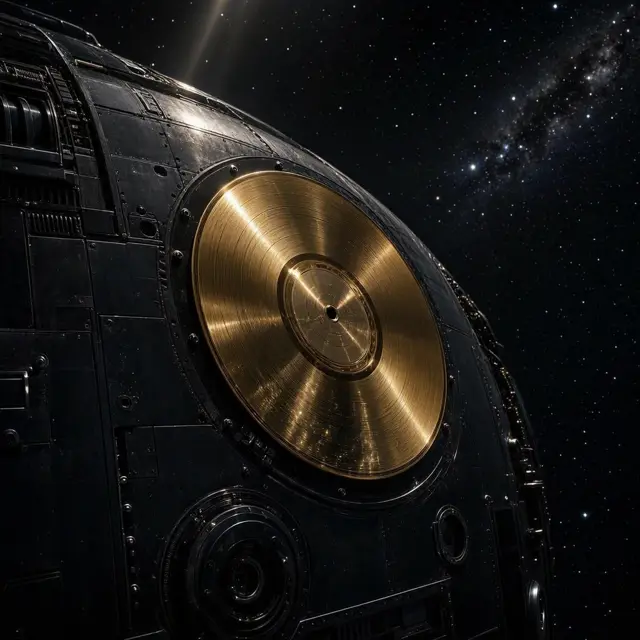
Laika flew because of a deadline. After Sputnik 1 stunned the world, Soviet leader Nikita Khrushchev demanded another triumph in orbit by November 7, 1957 — the 40th anniversary of the October Revolution. Engineers rushed Sputnik 2 from rough sketches to launch pad in a matter of weeks, with no plan for coming back: the technology to re-enter the atmosphere had not yet been developed. Laika's survival was never expected.
Her training was harsh. The candidate dogs were kept in progressively smaller cages for up to twenty days, spun in centrifuges that simulated launch stress, and taught to eat a gelatinous paste of bread crumbs, powdered meat, and beef fat. Before launch from Baikonur, technicians sponged her fur with a weak ethanol solution and painted iodine where the sensors would sit against her skin.
Four Orbits
Sputnik 2 lifted off on November 3, 1957. Laika's heart raced from a resting 103 beats per minute to 240 during ascent — and the mission began to unravel almost immediately. The rocket's core stage failed to separate from the capsule, crippling the thermal control system, and insulation tore loose. The cabin heated to 40°C.
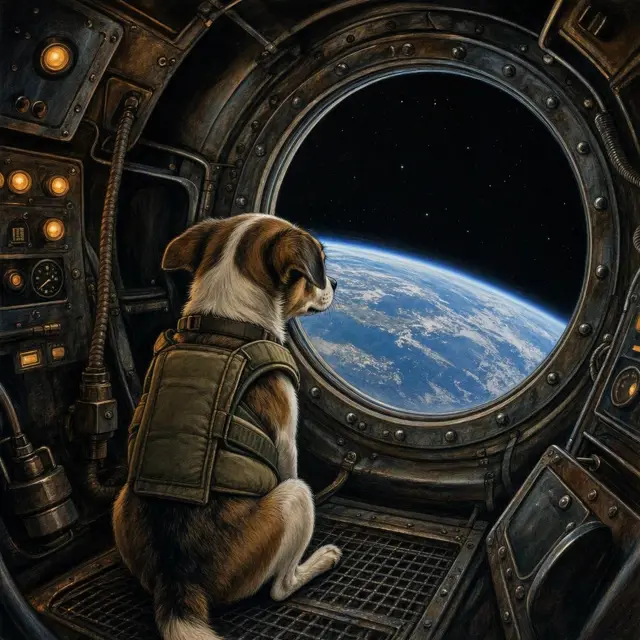
Within hours, the telemetry streaming her heartbeat and breathing back to Earth went silent. Laika died of overheating by her fourth orbit. Her empty spacecraft circled the planet 2,570 times before burning up in the atmosphere on April 14, 1958. She had proven a living creature could survive launch and function in orbit — the data that opened the road to human spaceflight.
The Truth Took 45 Years
For decades, Soviet officials told shifting stories: that Laika was painlessly euthanized, or that her oxygen simply ran out on day six. Only in October 2002 did scientist Dimitri Malashenkov reveal the truth — she had died of overheating within hours, because it had been practically impossible to build a reliable temperature control system in so little time.
The mission ignited protests even in 1957. Britain's National Canine Defence League called for a daily minute of silence, and demonstrators gathered outside the United Nations. The regret eventually reached the program itself. In 1998, Oleg Gazenko — one of the scientists who trained her — admitted: "The more time passes, the more I'm sorry about it... We did not learn enough from this mission to justify the death of the dog."
One Less Dog on Earth, One More Star
Laika's sacrifice reshaped the program that followed. Later missions were designed to bring their passengers home, and in 1960 the dogs Belka and Strelka returned safely from orbit aboard Korabl-Sputnik 2 — proving the path for human flight the next year.
Laika herself became a legend. She appears on Moscow's Monument to the Conquerors of Space, received her own statue at the Star City cosmonaut training facility in 1997, and in 2008 a monument of her standing atop a rocket was unveiled near the military research facility that prepared her flight. Her image spread across stamps and matchboxes worldwide, and she lives on in songs, films, and an award-winning graphic novel. A Spanish pop song put it simply: there is one less dog on the Earth, and one more star in the sky.