The Camera That Looked Back
On February 14, 1990, the Voyager 1 space probe was 6.055 billion kilometers from home — over 40 times the distance between Earth and the Sun — when it swung its camera around for one last look. The result was a family portrait of the Solar System, and hidden inside one frame, a speck: Earth, smaller than a single pixel.
The idea belonged to astronomer Carl Sagan, who had proposed it back in 1980 as Voyager passed Saturn. He admitted the picture would have no scientific value — Earth would appear far too small to study — but argued its meaning lay elsewhere. Planetary scientist Carolyn Porco independently conceived the same idea in 1983 and pushed for it too.
Why NASA Almost Said No
The photograph faced a decade of resistance. Engineers worried that pointing the camera anywhere near the Sun could damage the imaging system. Mission schedules were packed, budgets were shrinking, and other missions had priority on NASA's Deep Space Network antennas. It ultimately took the intervention of NASA Administrator Richard Truly to make the image happen.
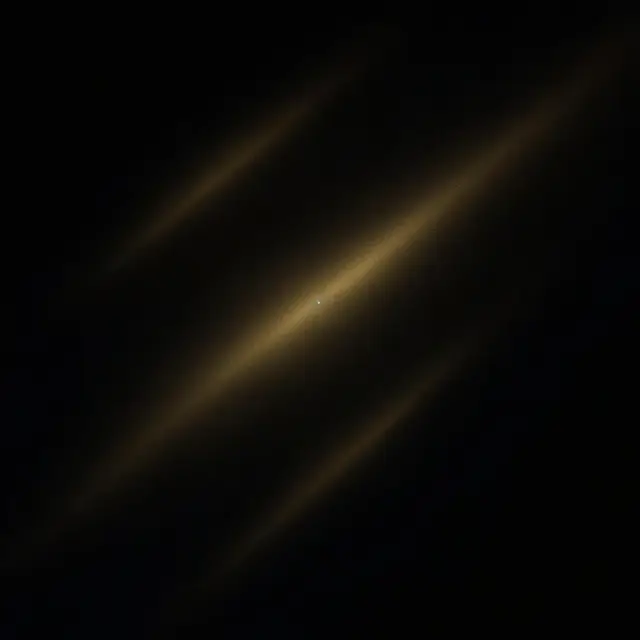
Voyager's narrow-angle camera shot three frames of Earth through blue, green, and violet filters, later combined into one color image. Earth occupies just 0.12 of a pixel out of 640,000 in the frame, caught inside a band of hazy sunlight scattered by the camera's own optics — an accident that made the tiny world look even more fragile. The data traveled nearly five and a half hours at the speed of light to reach Earth, and after the transmission, Voyager's cameras were switched off for good.
Why the Dot Is Pale and Blue
Earth's color in the photograph is a signature of what it is. Our atmosphere scatters short blue wavelengths of sunlight far more strongly than red ones — an effect called Rayleigh scattering, the same reason the daytime sky looks blue. Mixed with white light bouncing off clouds, the result from six billion kilometers away is a pale, milky blue.
That faint color says more than it seems. Earth's reflected light spectrum is unlike that of any other planet we have observed, and it correlates with an atmosphere rich in oxygen — oxygen produced by photosynthetic life. In other words, even reduced to a fraction of a pixel, Earth still manages to hint that something is alive on it.
That's Here. That's Home. That's Us.
In his 1994 book *Pale Blue Dot*, Sagan distilled the image into some of the most quoted lines in science: "That's here. That's home. That's us. On it everyone you love, everyone you know, everyone you ever heard of, every human being who ever was, lived out their lives." Our planet, he wrote, is "a lonely speck in the great enveloping cosmic dark."
The photograph keeps returning. NASA celebrated its 25th anniversary in 2015, and for the 30th in 2020 released *Pale Blue Dot Revisited*, a version reprocessed with modern techniques. Voyager 1 itself is still out there — the most distant human-made object, racing away at 64,000 kilometers per hour, long blind but still whispering data home.