A Mixtape for Aliens on a Shoestring Budget
When NASA prepared the two Voyager spacecraft for launch in 1977, project manager John Casani handed astronomer Carl Sagan a strange side quest: put a message aboard for anyone — or anything — that might one day find the probes. Sagan teamed up with Linda Salzman and Frank Drake, with a budget of just $1,500 for six weeks of work. They ended up dipping into their own pockets.
The team chose a copper phonograph record over magnetic tape because it would better survive the harshness of space. Deciding what belonged on it was harder — choosing the sounds, images, and music that would speak for an entire planet took nearly a year.
What Humanity Chose to Say
The record carries 116 images, from diagrams of DNA and the Solar System to photographs of landscapes, animals, food, and daily human life. Its audio side holds greetings in 55 languages, the sounds of surf, wind, thunder, birds, and whales, and a message from a six-year-old — Sagan's son Nick.
The music sparked the best arguments. Alongside Bach, Beethoven, and Mozart sit Bulgarian folk songs, Indian classical music, and Chuck Berry's Johnny B. Goode — included over the objection of an ethnomusicologist who called rock music "adolescent". Sagan's reply: "there are a lot of adolescents on the planet."
The Beatles' "Here Comes the Sun" almost made it, but record label EMI reportedly wanted $50,000 — when the whole production cost $18,000. Strangest of all: a one-minute recording of creative director Ann Druyan's brainwaves, captured while she thought about Earth's history and what it feels like to fall in love.
Built to Outlive Everything We Know
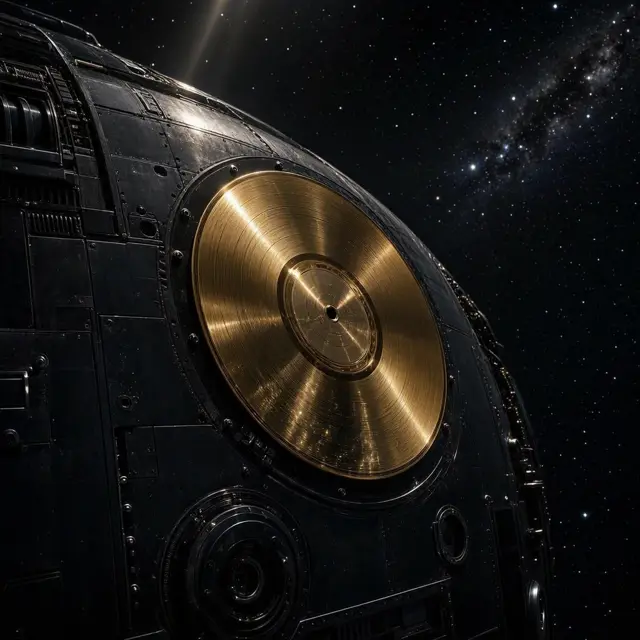
Each record is a copper disk plated with nickel and gold, 12 inches across, meant to be played at 16⅔ revolutions per minute. Its aluminum cover is electroplated with uranium-238 — a deliberate clock. Because uranium-238 decays with a half-life of 4.468 billion years, any finder can measure what remains and calculate how long the record has been traveling.
The cover also carries playback instructions written in binary, using the fundamental frequency of the hydrogen atom as a universal unit of time. One human touch nearly didn't survive: the hand-etched inscription "To the makers of music – all worlds, all times" wasn't in the specifications, and the record was initially rejected because of it. Sagan had to convince administrators to let it fly.
Where the Bottle Is Now
Voyager 1 crossed into interstellar space on September 12, 2013, carrying its record with it. Neither probe is aimed at any particular star, but in about 40,000 years Voyager 1 will drift within 1.6 light-years of the star Gliese 445, while Voyager 2 approaches Ross 248.
Back home, the record refuses to be forgotten. NASA uploaded its sounds to SoundCloud in 2015, and a 2017 Kickstarter for a 40th-anniversary vinyl edition raised over $1.4 million — winning a Grammy Award in 2018. Sagan said launching this "bottle" into the "cosmic ocean" says something hopeful about life on Earth. The message may never be found. It was still worth sending.