Seventy-Two Seconds in August
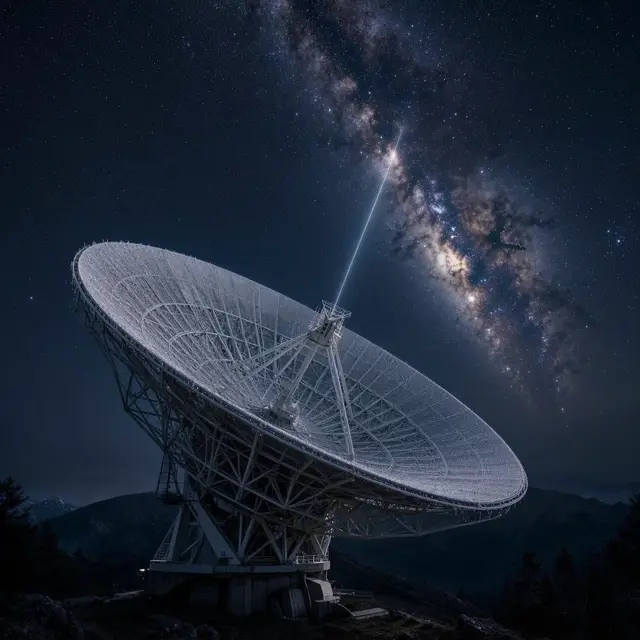
On August 15, 1977, Ohio State University's Big Ear radio telescope was quietly sweeping the sky in support of the search for extraterrestrial intelligence. Days later, astronomer Jerry R. Ehman sat reviewing the computer printouts and froze. One column of characters recorded a signal so intense it towered over everything around it.
Ehman circled the reading — 6EQUJ5 — and wrote "Wow!" beside it in red pen. The name stuck. The burst had lasted exactly 72 seconds, which was precisely how long Earth's rotation kept any single point of sky inside Big Ear's listening window. Whatever it was, it behaved like a source fixed among the stars, not something local. The original printout is preserved by the Ohio History Connection.
The Frequency Aliens Would Choose
The characters 6EQUJ5 are often mistaken for an encoded message. They are simply an intensity scale — and the "U" meant the signal peaked at about 30 standard deviations above background noise, extraordinarily strong.
What made astronomers' hearts race was the frequency: roughly 1420.4556 MHz, sitting just above the natural emission frequency of hydrogen, the most common element in the universe. Back in 1959, Cornell physicists had argued that any civilization wanting to be heard would broadcast near this hydrogen line, since every radio astronomer in the galaxy would be listening there. The signal was also narrowband — concentrated in a sliver of spectrum, the way artificial transmissions are, not the broad smear natural sources usually produce. It seemed to come from the constellation Sagittarius.
Every Explanation Has a Hole in It
Nearly five decades of hypotheses have failed to close the case. A 2017 claim that hydrogen clouds around two comets could explain the signal was dismissed — including by members of the original Big Ear team — because the comets were not in the beam at the right time.
Ehman himself once suggested an Earth signal reflecting off space debris, but later research showed a reflector would need unrealistic properties to produce what was observed. Interstellar scintillation — a distant steady source "twinkling" into brief brightness — remains possible, though it wouldn't rule out an artificial origin. In 2024, researchers proposed a sudden brightening of a cold hydrogen cloud energized by stellar emissions. No explanation, terrestrial or otherwise, has ever been confirmed.
Listening for an Echo That Never Came
The signal's greatest weakness is that it never repeated. Ehman searched again with Big Ear in the months after. Robert Gray hunted it with the META array in the late 1980s, then with the far more sensitive Very Large Array in 1995–96. Six 14-hour observations from Tasmania in 1999 heard nothing.
The fascination refuses to fade. On the 35th anniversary in 2012, the Arecibo Observatory beamed a reply toward the signal's direction containing about 10,000 Twitter messages — and the transmitter overheated in the process. By 2019 Ehman said he was convinced the signal has the potential of being the first detected transmission from extraterrestrial intelligence, though SETI researchers stress that an unrepeated detection can never be confirmation. In 2022, astronomers even identified a distant sun-like star in the search field, 1,800 light-years away, as a candidate home.